
Why Long Horizons Are Hard
Most SMEs plan 1–3 years ahead due to cash flow pressures and daily operational pace. This creates a systematic blind spot for the slower-moving, structural changes that ultimately reshape industries — precisely the changes that determine which organisations survive them.
Practical Approaches
- Regularly scan for weak signals of emerging change
- Use scenario planning to explore 3–4 plausible futures
- Identify early warning indicators to track which future is materialising
- Connect long-term insights to near-term strategic decisions
Looking 10–20 Years Ahead

Horizon thinking means stepping outside immediate pressures to consider how larger structural transformations may evolve over time. Strategic choices made today may produce consequences — positive or negative — many years into the future.
Goal: explore possible long-term developments and build the ability to adapt proactively, not reactively.
Why Long Horizons Are Hard
Present Bias
We assume the future will resemble the present — systematically underestimating the scale of major disruptions.
Systemic Complexity
Technological, social, economic, and political changes interact in ways that are difficult to trace or predict in isolation.
Short-Term Pressure
Operational demands and quarterly targets consistently crowd out long-term reflection and strategic planning time.
Organisational Inertia
Success today can create resistance to questioning the assumptions that underpin tomorrow’s strategy.
Practical Approaches to Horizon Thinking
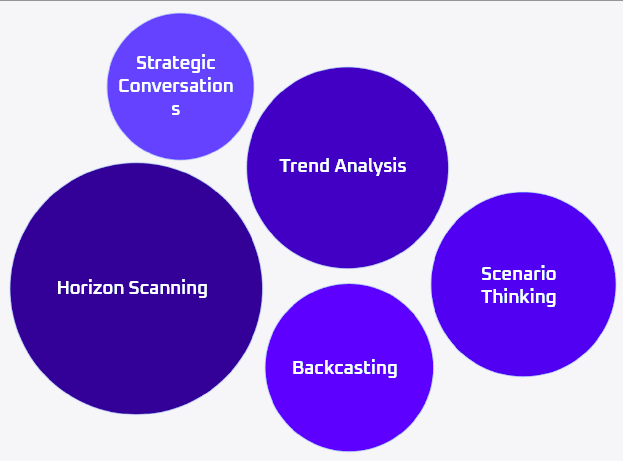
These five tools are not sequential steps — they are complementary practices that SMEs can adopt at different levels of complexity, starting with horizon scanning and strategic conversations.