
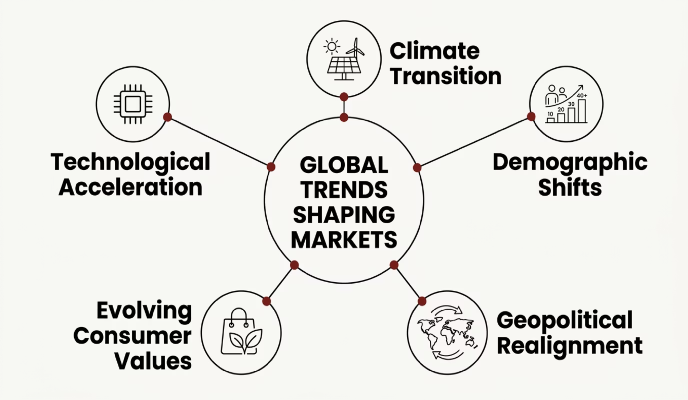
Identifying and reading these trends — and understanding how they interact — is a core foresight skill. Sector case studies from Germany, Denmark, Spain, and France illustrate how these forces play out differently across industries and markets
Identifying and Reading Trends
Detect Weak Signals
Look for early indicators of change that are not yet mainstream — emerging technologies, regulatory shifts, changing social behaviours.
Distinguish Trends from Noise
Not every signal becomes a trend. Apply structured analysis to assess which signals are gaining momentum and which are transient.
Map Interactions
Trends rarely operate in isolation. Understanding how technological, social, and economic forces interact reveals the most significant strategic implications.
Translate to Strategic Implications
Ask: what does this trend mean for our sector, our customers, and our business model over the next 10–20 years?
Understanding Trends in Foresight
1 Megatrends
Large-scale global transformations — climate change, digitalisation, demographic ageing, urbanisation.
2 Sector Trends
Automation in manufacturing, telemedicine, personalised learning — reshaping specific industries.
3 Weak Signals
Early, marginal indications of change that may evolve into major transformations over time.
Key question: not just "what is changing?" but "how could this affect our customers, workforce, or business model?"
Trends Don’t Work in Isolation
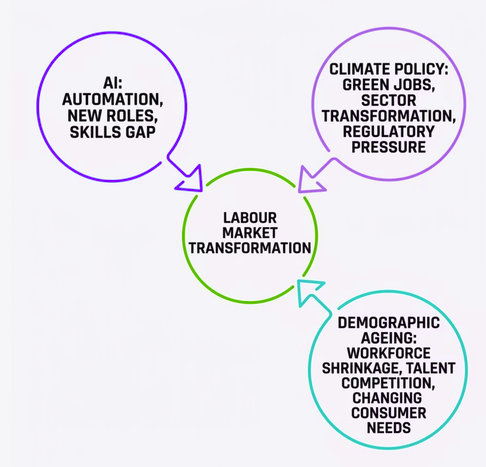
AI, climate policy, and demographic ageing are already influencing labour markets simultaneously. Organisations that analyse trends in isolation may miss how combined effects reshape entire industries.
Missing the intersection of trends is one of the most common — and costly — strategic blind spots for SMEs.
LTFF encourages reading trends critically:
- What assumptions support the narrative around it?
- How mature is this trend?
- Is it accelerating or plateauing?