
Definition
“Business models are necessary features of market economies where there is consumer choice, transaction costs, and heterogeneity amongst consumers and producers, and competition. Profit seeking firms in competitive environments will endeavour to meet variegated consumer wants through the constant invention and presentation to the consumer of new value propositions.” (Teece, 2010)
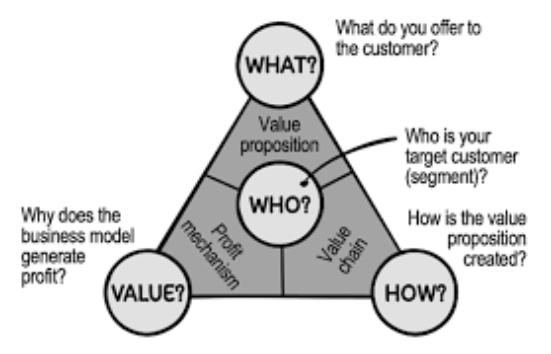
The purpose of The St. Gallen Magic Triangle (Gassmann et al. 2019) is to provide a better understanding of the most important driving forces that characterize successful business models, and to promote innovation of business models via a structured approach
What do they do? (Chesbrough & Rosenbloom, 2002)
- Articulate the value proposition (i.e., the value created for users by an offering based on technology)
- Identify a market segment and specify the revenue generation mechanism (i.e., users to whom technology is useful and for what purpose)
- Define the structure of the value chain required to create and distribute the offering and complementary assets needed to support position in the chain
- Detail the revenue mechanism(s) by which the firm will be paid for the offering
- Estimate the cost structure and profit potential (given value proposition and value chain structure)
- Describe the position of the firm within the value network linking suppliers and customers (incl. identifying potential complementors and competitors)
- Formulate the competitive strategy by which the innovating firm will gain and hold advantage over rivals
Elements of Business Models Design
“To profit from innovation, business pioneers need to excel not only at product innovation but also at business model design, understanding business design options as well as customer needs and technological trajectories. Developing a successful business model is insufficient to assure competitive advantage as imitation is often easy: a differentiated (and hard to imitate) e yet effective and efficient e business model is more likely to yield profits.” (Teece, 2010)
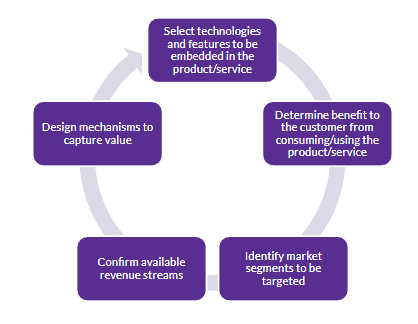
“A mediocre technology pursued within a great business model may be more valuable that a great technology exploited via a mediocre business model” (Chesbrough, 2010)
Experimenting with Business Models: Business Model Innovation
“Undertaking active tests to probe nascent markets with new potential configurations of the elements of a business model can allow a firm to learn ahead of the rest of the market, and to begin to generate the new data that can power its change process.” (Chesbrough, 2010)
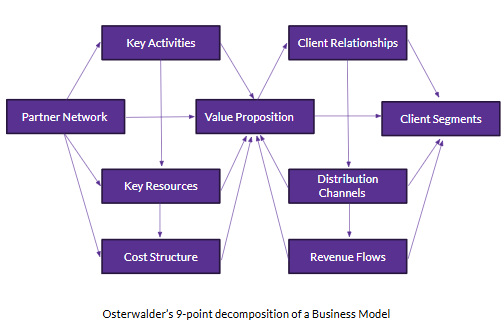
“Business model innovation provides a pro-active way to actually experiment with alternative business models, by enabling firms to simulate various possibilities before committing to specific investments in reality.” (Chesbrough, 2010)