
Every organisation has silos. Even in small companies with fewer than 20 people, technical teams rarely talk to sales, operations rarely coordinates with strategy, and no one has a full picture of where the business is headed. This is not a failure of individuals — it is structural and cultural. But for long-term foresight, silos are particularly damaging: they fragment information and prevent the collective intelligence that makes strategic anticipation possible.

What Is an Organisational Silo?
A silo is a situation in which people, teams, or departments work in isolation — with limited communication, little shared knowledge, and few joint processes. Research across European SMEs in the ASTRAL project found that cross-department communication was among the most frequently cited barriers to strategic thinking — in companies of all sizes.
Task: In a team of 8–10 people, a silo between the founder and technical staff can be just as damaging as a silo between divisions in a large enterprise.
Why Do Silos Form? Five Root Causes
Functional Specialisation
Teams develop their own vocabulary and priorities. A developer and a sales manager may not share enough language for a strategic conversation.
No Shared Spaces
Without regular moments designed for cross-team dialogue, people simply never have the opportunity to think together.
Scarce Time & Bandwidth
In resource-constrained SMEs, cross-team coordination feels like an additional burden rather than a core activity.
Leadership Blind Spots
When leaders do not model cross-functional thinking or create explicit opportunities for it, the default is isolation.
Reward Structures
When teams are measured only on their own outputs, there is no incentive — and sometimes a disincentive — to invest in shared thinking.
The Foresight Cost of Silos
Fragmented Signal Detection : Weak signals about emerging technologies or market shifts appear across customer conversations, technical literature, and supplier updates. When teams don’t share what they notice, the dots never get connected.
Strategy Without Ownership: When a long-term vision is developed in isolation, it often fails to gain traction. People do not commit to a future they had no part in imagining.
Blind Spots in Scenario Planning: Scenarios built by a single function will systematically miss risks and opportunities visible from other perspectives — operations, commercial, or customer service.
Slow Response to Change: Organisations that already share a common view of the future adapt faster and at lower cost than those requiring lengthy internal negotiation before acting.

Real-World Example: The Cost of Silence
A 35-person manufacturing SME spent two years developing a precision component for industrial automation. When it reached market, sales struggled — customers wanted remote diagnostics and cloud connectivity. The sales team had been hearing about these needs for 18 months. But there was no process for sharing that intelligence with the development team. The foresight failure was not a lack of information — it was a silo.
Six Silo-Breaking Techniques
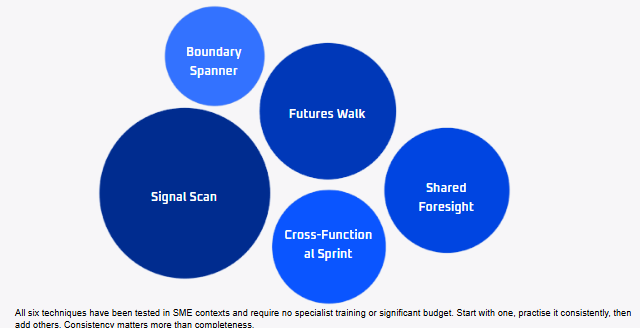
Techniques 1–3: Information Flow
Cross-Team Signal Scan:A 15–20 min monthly meeting where one person from each team shares one external signal they’ve noticed. Institutionalises cross-team information flow without adding significant workload.
Futures Perspective Walk: Each participant describes a strategic challenge from the perspective of a different function — not their own. Builds empathy and a richer understanding of how the future affects the whole organisation.
Shared Foresight Document: A single living document — digital or physical — where anyone can add signals, questions, or observations. Makes strategic intelligence visible across the whole organisation.
Techniques 4–6: Structure & Culture
Cross-Functional Foresight Sprint: A focused half-day or full-day session where people from different functions work together on a specific foresight question. A defined output reduces friction of cross-team working.
Boundary Spanner Role: One person — or a rotating role — whose explicit task is to connect conversations across functions and ensure foresight-relevant information doesn’t get trapped in a single team.
Assumption Audit: A structured conversation where different teams surface and compare their assumptions about the future. Making assumptions explicit is the first step to aligning them.
Quick match guide: Signal Scan (15–20 min, ongoing) • Perspective Walk (30–45 min, 3–8 people) • Sprint (half-day, 5–15 people) • Assumption Audit (45–60 min, 4–12 people)