
A foresight role is different from a job title. It describes the cognitive and collaborative contribution a person makes to the process of thinking about the future. A sales manager might be an excellent Challenger; a technical lead might be the best Scout in the room.
More Intentional: People know what they are contributing and why it matters.
Reveals Gaps: If nobody plays the Challenger, the team risks groupthink.
Creates Permission: Non-strategy staff can contribute as Analysts or Scouts without feeling they are overstepping.
The Six Foresight Collaboration Roles
The Scout — Signal Detector
Actively monitors the external environment for weak signals and emerging trends. Broad curiosity and peripheral vision. Risk if absent: tunnel vision; critical signals arrive too late.
The Analyst — Pattern Finder
Takes signals and identifies patterns, connections, and trajectories. Translates raw information into structured insight. Risk if absent: signals pile up without synthesis.
The Challenger — Assumption Breaker
Deliberately questions the group’s assumptions and pushes the team to consider scenarios it would prefer to avoid. Risk if absent: groupthink; comfortable futures confirmed.
The Connector — Bridge Builder
Identifies connections between different perspectives and disciplines. Notices when two people are saying the same thing in different languages. Risk if absent: fragmentation; contributions remain isolated.
The Builder — Action Translator
Takes foresight insights and translates them into concrete actions and plans. Asks ‘so what do we do about this?’ Risk if absent: rich insights but no change in behaviour or strategy.
The Facilitator — Process Guardian
Designs and guides the foresight process — managing time, ensuring all voices are heard, creating psychological safety. Risk if absent: dominant voices take over; group leaves without shared conclusions.
What Happens When Roles Are Missing
| Missing Role | Typical Symptom | What the Team Says |
|---|---|---|
| No Scout | Analyses the same information it has always had | “We already know what the trends are.” |
| No Analyst | Signals pile up without synthesis | “We have a lot of interesting information but never get anywhere.” |
| No Challenger | Rapidly converges on a single comfortable view | “We all agreed very quickly — that was productive.” |
| No Connector | Diverse perspectives sit in parallel | “Everyone had good points but we went in circles.” |
| No Builder | Insight but no action; same conversations repeat | “We know what the future might look like — we just never do anything differently.” |
| No Facilitator | Dominant voices crowd out quieter ones | “The usual people talked. The usual conclusions were reached.” |
SCENARIO: Collaboration Roles Simulation: FERROTEC 2035
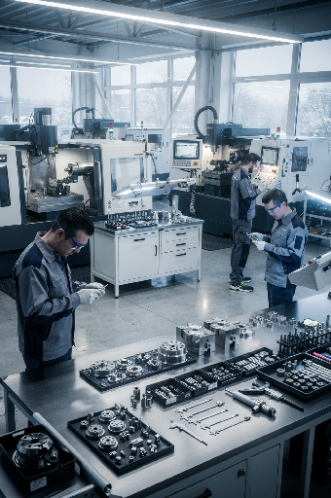
Scenario: You are the strategic leadership team of FERROTEC, a 45-person SME manufacturing precision components for industrial machinery across Germany, Spain, and Denmark. Your question: “What are the most significant forces reshaping our business between now and 2035 — and what should we do about them in the next 18 months?”
Background signals: clients announcing carbon-neutrality targets by 2030 • competitor offering digital-twin integration • new EU supply chain traceability regulation • two senior engineers retiring within 5 years • AI-assisted quality control startup closing Series B
Simulation: How It Works
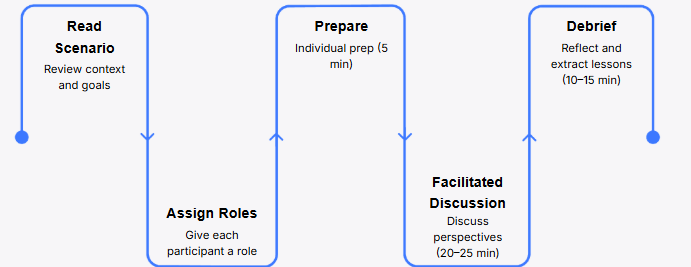
Each participant is assigned a specific role and must contribute from that perspective — even if it feels unfamiliar. The debrief is where the deepest learning happens. Adapt for team size: 6 people (one role each), 4–5 (combine Connector+Builder or Scout+Analyst), 3 (Scout, Challenger, Builder).