
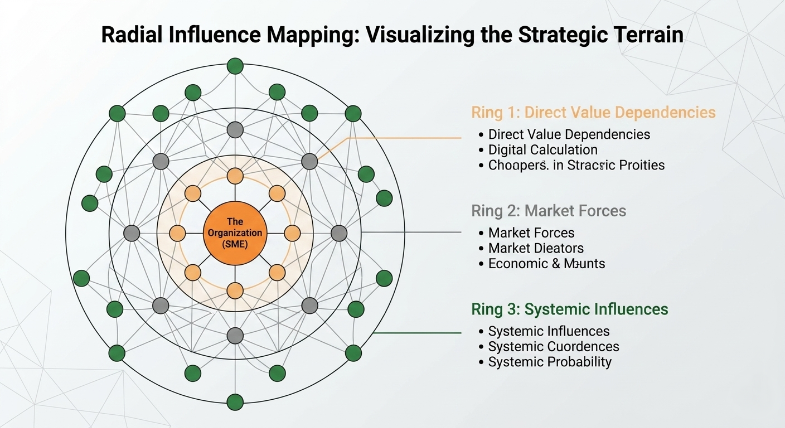
Part B shifts from internal collaboration to the wider landscape. Ecosystem mapping helps you understand who the key actors are, how they relate to you, and where the strategic opportunities and risks lie in your operating environment.
What Is an Innovation Ecosystem?
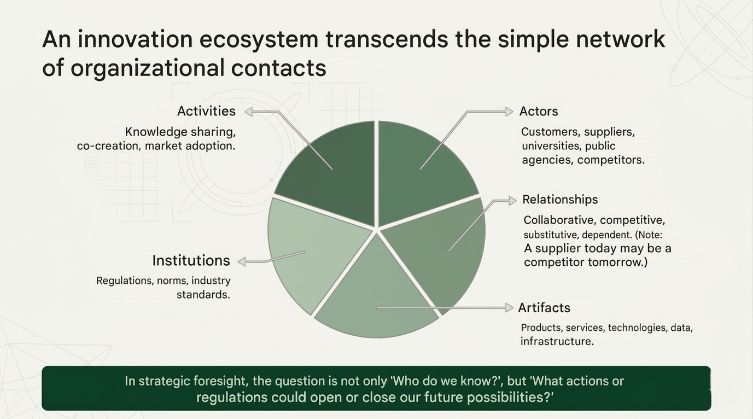
An innovation ecosystem is the network of interdependent organisations, institutions, and individuals whose interactions shape the conditions for innovation and value creation in a sector or region. For SMEs, understanding this ecosystem is essential for long-term foresight.

An innovation ecosystem is more than a network of contacts or a list of partners. It is the evolving set of actors, activities, artifacts, institutions, and relationships that shape an organisation’s innovative performance.
- Includes not only people and organisations, but also technologies, knowledge, data, standards, regulations, and infrastructure
- Relationships are not only collaborative — they can be competitive, substitutive, dependent, or complementary
Mapping Your Stakeholders & Relationships
Customers & Users
Needs, feedback, adoption signals — demand-side & co-creation
Competitors & Substitutes
Pressure, benchmarks, disruption signals — competitive & substitutive
Regulators & Public Bodies
Rules, funding, legitimacy — institutional & enabling
Suppliers & Tech Providers
Inputs, infrastructure, technical capability — dependency & complementarity
Research & Knowledge Actors
Universities, labs, consultants — knowledge exchange & exploration
Networks & Intermediaries
Clusters, associations, accelerators — bridging & coordination
Reading the Ecosystem: Opportunities
Access to External Knowledge
Partners and networks reveal weak signals and emerging technologies earlier than internal scanning
Co-Innovation
Complementors and lead users help develop new products, services, or business models
Market Access & Legitimacy
Partnerships with trusted actors help SMEs enter new markets or gain credibility
Shared Resources
Access to infrastructure, talent, data, or funding that SMEs could not afford alone

Reading the Ecosystem: Risks

⚠️ Dependency Risk: Over-reliance on one supplier, platform, or funder reduces strategic freedom
🔓 Knowledge Leakage: Collaboration can expose sensitive capabilities or strategic intentions
⚖️ Power Asymmetry: Larger actors may capture disproportionate value or set rules smaller firms must follow
🌊 Ecosystem Disruption: New regulations, technologies, or entrants can quickly change who matters and where value is created