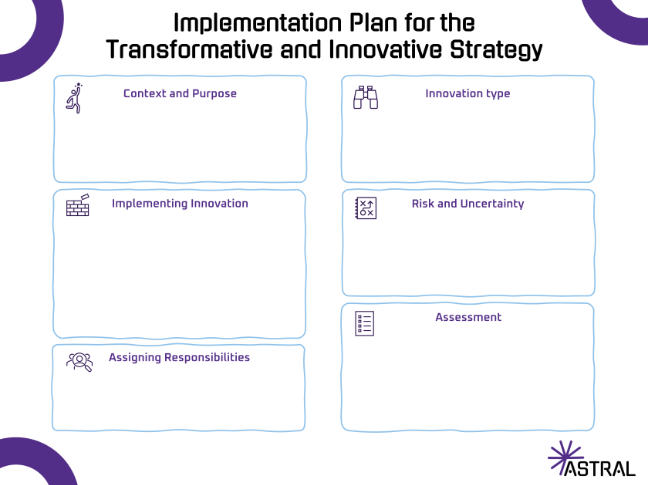
The following section will provide you with several reflective questions meant to aid you in the construction of transformative and innovation strategy and the implementation plan for it. It is recommended to involve several colleagues and potentially key stakeholders in the creation of the strategies and plan, as this creates a shared vision that is easier to implement.
Context and Purpose:
What would “successful transformation” look like for our organization?
Why is transformative and innovation strategy needed?
What challenges, opportunities, or uncertainties make innovation necessary at this point in time?
If we do nothing, what are the most likely outcomes?
Which strategic goals (e.g. growth, sustainability, competitiveness, resilience) should innovation support?
Do we want more innovation?
Defining the innovation type:
- What type of innovation is our organization engaged in?
- Are we aiming primarily for incremental improvement or more radical change? And why?
- In which areas do we want to innovate (product, process, position, paradigm)?
- In which areas do we currently innovate?
- Why do we not innovate in some areas?
- How could we innovate in the overlooked areas?
- Where does our organization source its innovation?
- Where are our most promising innovation ideas likely to come from (employees, users, partners, research, data)?
- How could underused potential sources of innovation be integrated into our organization?
- Would it be beneficial to include these sources of innovation? And why?
- Which internal silos might need to be bridged to enable innovation?
- Do we have pipelines specifically for innovation?
- How could such pipelines be implemented?
- Which external actors (customers, suppliers, universities, startups, public institutions) could be valuable partners?
- What capabilities, resources, or assets do we already possess that can support innovation?
- Which capabilities are missing or underdeveloped? And how could they be developed?
- What areas should the organization focus on in terms of innovation efforts?
Implementing innovation:
- What ideation techniques could be useful or fun to try to find innovative solutions?
- How can we facilitate them?
- How can we ensure innovative solutions?
- Do we always use the same methods and places to be creative?
- Where and how is our teams creative?
- What Break-the-Pattern ideas could be implemented?
- How could they be implemented?
- How do we ensure a balance between change and stability?
- Where do we experience rigidity, inefficiencies, or repeated frustrations?
- Do we always use the same methods and places to be creative?
- How can we quickly test ideas or assumptions generated through the ideation sessions?
- In general, which assumptions about our market, customers, or operations might need to be challenged? And how could we go about confirming or rejecting these?
- Where might constructive deviance or prosocial rule‑breaking be beneficial?
- What systems can we put up to facilitate this?
How can implement these systems?
Risk and uncertainty:
- What types of uncertainty (technological, market, regulatory, social, timing) are most relevant to our organization? And why?
- What risks and uncertainties are acceptable, and which are not?
- Which of these uncertainties can be reduced through experimentation, learning, or collaboration?
Assessment:
- How will we recognize early signs that an initiative is failing or succeeding?
- What indicators will tell us that transformation is genuinely taking place?
- Do key stakeholders share a common understanding of the innovation goals?
- Where might resistance arise, and how can it be addressed constructively?
- When should the initiatives be assessed?
Assigning responsibilities:
- Who should be involved in shaping and refining the different sections of the strategy and implementation plan?
- Who should carry out the Assessment
As a starting point: “What is one assumption you are willing to test immediately?”