

1. Executive Summary
The Deliverable 1.1 presents the results of Work Package 1 (WP1) of the ASTRAL project and draws conclusions based on these to create the foundations for subsequent work packages. WP1 employed a multi-method approach to identify the needs, skills and methodological gaps, barriers, and recommendations and success factors for the ASTRAL course of the target groups:
- Managers, owners & entrepreneurs from the high-tech/deep-tech sector (SMEs)
- Higher Education Institution (HEI) teachers and Vocational Education and Training (VET) trainers in fields related to strategy, STEM, high-tech/deep-tech, (and dependent) industry and innovation.
- Target group of strategic foresight and innovation professionals (independent professionals as well as those belonging to business associations, innovation intermediaries, public bodies, etc.).
The research activities included (1) bibliometric desk research to uncover key challenges, needs, and methods in Long-Term Future Foresight (LTFF), (2) expert interviews to hear the target groups’ needs, thoughts, opinions, and how they work with foresight currently, (3) a targeted survey to gather quantitative data on current foresight practises, (4) a gap analysis consolidating the results of the previous three tasks, and (5) focus groups where findings were validated, discussed, and expanded. Moreover, the focus groups aided in the identification of course recommendations and success factors. These activities were conducted with representatives from the target groups across all five countries represented in the consortium – Germany, Spain, France, Denmark, and the Netherlands. Furthermore, all KPIs for WP1 were achieved.
1.1 Results
The results were structured around six thematic areas:
Needs: The analysis revealed a lack of structured foresight practices, theoretical grounding, and integration with strategic decision-making.
Skills: A diverse set of skills was identified. These include core foresight skills, analytical and cognitive skills, soft skills, and digital skills.
Methods: Many organisations rely on ad-hoc approaches, and structured methods are applied unevenly. Additionally, multiple methods for possible integration into the ASTRAL curriculum were identified, such as Scenario planning, the Delphi method, Backcasting, trend analysis, and Horizon scanning.
Barriers: Several barriers hinder the adoption of LTFF practices. These include structural, institutional, methodological, educational, psychological, cultural, technological, and legal barriers.
Course Recommendations: Participants across all formats emphasised the need for a modular, flexible, and context-conscious course with interactive tools and case-based learning approaches.
Success Factors: Enablers for successful implementation include contextual relevance, low-threshold entry points, leadership engagement, and community engagement.
Based on the findings, the consortium constructed a prototype curriculum that targets the specific needs and requirements identified.
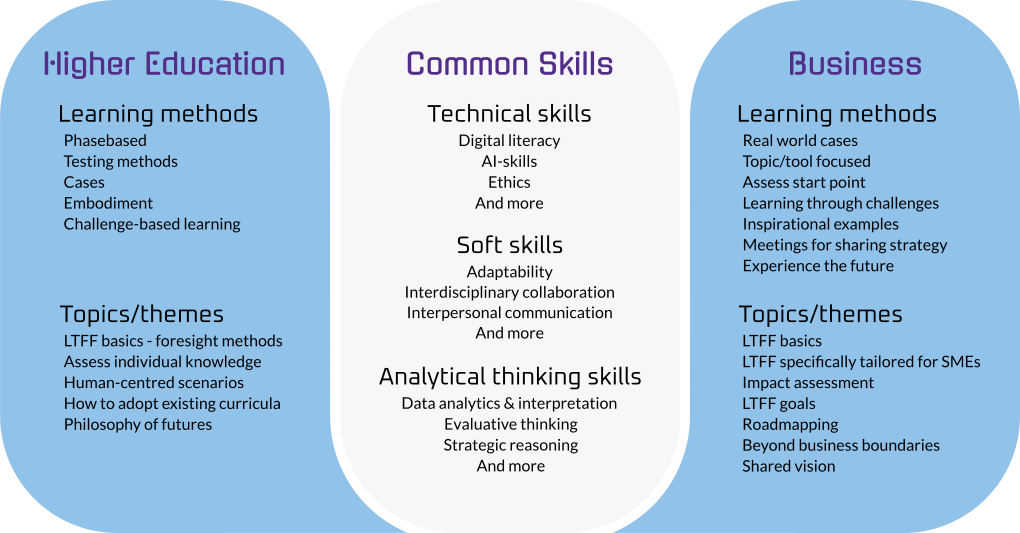
1.2 WP2 – ASTRAL LTFF Curriculum for the world of Higher Education
WP2 focuses on equipping higher education teachers with the competencies needed to prepare students for strategic and innovation roles that require LTFF. The curriculum will be co-designed and co-created with educators and learners in HEIs. Key elements will include a flexible approach for circular learning and a syllabus for HEI teachers.
1.3 WP3 – LTFF training for the world of Business
WP3 targets business support staff and professionals, who need to apply LTFF in strategic planning and innovation. The curriculum will be co-designed with the target groups and will include case-based and challenge-driven learning. Furthermore, the course will utilise an adaptable content framework for AI-driven personalisation.
1.4 Work Package 4 – ASTRAL Cooperation Labs
WP4 introduces a collaborative format that brings together the world of education, business, and policy. In Cooperation Labs the stakeholders can co-create solutions to real-world challenges. These challenges will be both place- and theme-specific. A piloting phase will use a Mini Living Lab approach, where the three stakeholders can engage in collaborative boot camps and co-create innovation initiatives. WP4 will facilitate cross-sector collaboration and ensure that LTFF practices are spread and used in real-world decision-making processes.