
Types of Innovation – Definition
Innovation can be understood in many ways, and numerous definitions exist. From a product-oriented view, innovation can be defined as “an invention plus business plan”. The business plan allows the facilitation value creation and capture, which is the core behind turning an invention into an innovation. This definition limits the scope of what innovation can be. The OECD, who makes guidelines for collecting, reporting and using data on innovation, has made a more comprehensive definition:
“An innovation is a new or improved product or process (or combination thereof) that differs
significantly from the unit’s previous products or processes and that has been made available to
potential users (product) or brought into use by the unit (process).” (OECD/Eurostat, 2018, p. 20)
Although this definition encompasses many aspects, the core ideas are:
- Innovation must involve something new or improved, and
- Innovations need to be made available to or used by potential users.
But why innovate? Innovation is strongly correlated with growth as it creates new business opportunities, strengthen existing position, and generates competitive advantages (Tidd & Bessant, 2018). Therefore, innovation is a crucial aspect for an organization to survive and grow.
Types of Innovation – Degrees of Novelty
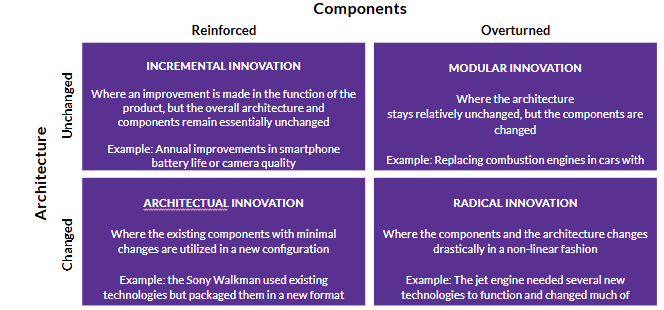
Innovation types can be separated based on the degree of novelty, where the least novel type is called: incremental innovation and the most novel: radical innovation. Henderson & Clark (1990) developed a terminology to describe the different types of innovation based on a 2×2 model. They identified two dimensions in which to describe types of innovation:
- Changes to components (1), and
- Changes to the system in which these components are situated or the architecture (2).
The matrix is not supposed to divide the world of innovation into four neat categories but is made to suggest that a given innovation can be more architectural or less radical.
1) Components are the parts of a product or system
2) Architecture is how the parts of a system or product are arranged and interact
Types of Innovation – Degrees of Novelty
Types of Innovation – Dimensions
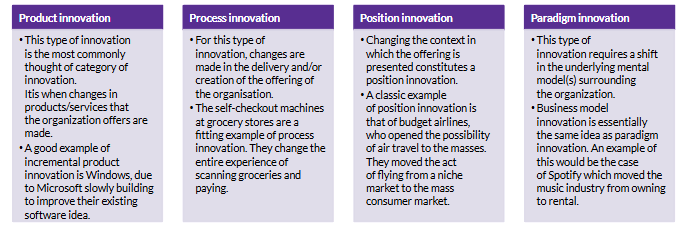
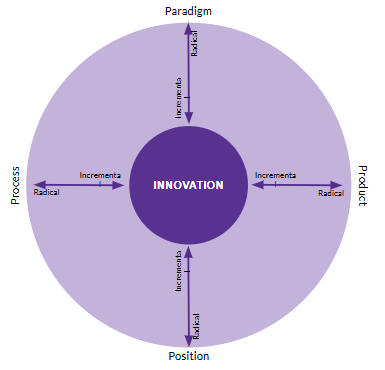
Innovation can additionally be categorized in four key areas according to Tidd & Bessant (2018). These four areas constitute the available space in which an organization can innovate.
4Ps of Innovation
Types of Innovation – Dimensions
These four types of innovation are not mutually exclusive and often exist in combination. An example of this is Spotify’s streaming model:
Product: a new digital music platform
Process: a new way of delivering music
Position: redefining how people engage with music
Paradigm: shifting the entire industry’s mental model on how to deliver a service
By understanding these innovation frameworks by Henderson & Clark (1990) and Tidd & Bessant (2018), organizations can identify the nature of their innovation and map which types they are engaging with. This can highlight unexplored areas for potential exploitation.