
This page uses the completed matrix to compare options and explain a proportionate response.
From the Matrix to Decision Options
For the chatbot example, the organisation has several possible choices:
- Full launch
- Controlled pilot
- Delay and redesign
- Do nothing
Visual: Possible Decision Options
A full launch serves all customers; a controlled pilot tests with a smaller group. Delaying allows redesign, while doing nothing leaves the current service in place. Compare what each option gains, reduces, or gives up.
For each option, ask:
- Which opportunities does this option capture?
- Which risks does it reduce?
- Which risks remain?
- What is the main trade-off?
- Which option best fits the situation?
These questions reveal that gaining a benefit may involve accepting a disadvantage. That balance is a trade-off.
Understand the Trade-Offs
A trade-off means gaining something while accepting that something else may be limited, delayed, reduced, or lost.
| Common Trade-Off | What It Means |
|---|---|
| Speed vs. Safety | Acting quickly may create value, but may also increase mistakes |
| Innovation vs. Reliability | A new solution may be promising, but less tested |
| Cost Saving vs. Quality | A cheaper option may reduce costs but affect service quality |
| Automation vs. Human Trust | Automation may save time while users still value human support |
| Data Use vs. Privacy | More data may improve services but increase privacy concerns |
| Short-Term Benefit vs. Long-Term Resilience | A quick win may not support the best long-term outcome |
Key idea:
There is rarely an option with all the benefits and none of the disadvantages. Good decision-making requires deciding which trade-offs are acceptable.
Compare the Options
Use those trade-offs to compare the chatbot options below. “Best fit” describes the judgement in this example, based on its identified risks and benefits.
| Option | Main Benefit | Main Risk | Main Trade-Off | Decision Fit |
|---|---|---|---|---|
| Full launch | Fast benefits | All customers are exposed to mistakes | Speed vs. safety | Too risky |
| Controlled pilot | Learn while limiting exposure | Some risk remains | Learning vs. control | Best fit |
| Delay and redesign | Lower risk later | Benefits are delayed | Safety vs. momentum | Possible |
| Do nothing | No new risk | Missed opportunity | Stability vs. improvement | Weak |
Visual: Comparing the Options
The comparison points towards a controlled pilot. Before accepting that conclusion, check why it fits the situation and which conditions would make it acceptable.
Move from Analysis to Decision
A score of 16 for an opportunity and 15 for a risk does not mean “go ahead.” The scales are judgement aids: consider who is affected, what safeguards are feasible, and when to review the decision.
Before deciding, ask four questions:
1. What is the strongest opportunity?
Which potential benefit has the greatest positive impact?
2. What is the most serious risk?
Which negative consequence deserves the greatest attention?
3. Can the risk be reduced?
Could safeguards, training, limits, redesign, or a pilot reduce it?
4. What response is proportionate?
Should you:
- Pursue
- Pilot
- Redesign
- Monitor
- Avoid
Key idea:
A good decision is not always the option with the highest opportunity or the lowest risk. It is the option that offers an appropriate balance between value, risk, feasibility, and responsibility.
You have identified the benefit, the main risks, and ways to reduce them. Use that reasoning to choose a response for the chatbot.
Make the Decision
For the chatbot example, the analysis suggests:
Pilot the chatbot with safeguards.
This allows the organisation to explore the opportunity while limiting exposure to the most important risks.
Possible Safeguards
- Test with a small customer group
- Keep a route for customers to speak to a person
- Define what data must never be entered
- Review chatbot answers regularly
- Train staff to monitor errors
- Review the results after an agreed period
The pilot follows from this example’s risks and trade-offs. Another situation may justify a different response.
A choice is easier to assess when others can see how you reached it. Connect the opportunity, concern, response, and safeguard in a short explanation.
Explain the Decision Clearly
Explain your choice using four short statements:
Because…
State the strongest opportunity.
But…
State the most important risk or uncertainty.
Therefore…
State the decision.
With…
State the safeguard, condition, or next step.
Example
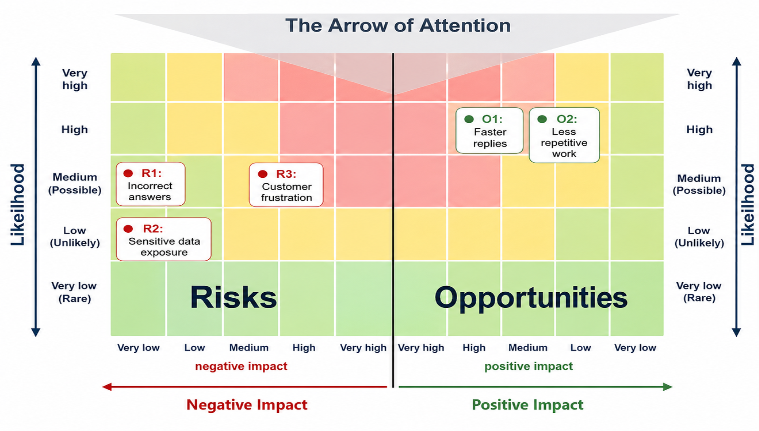
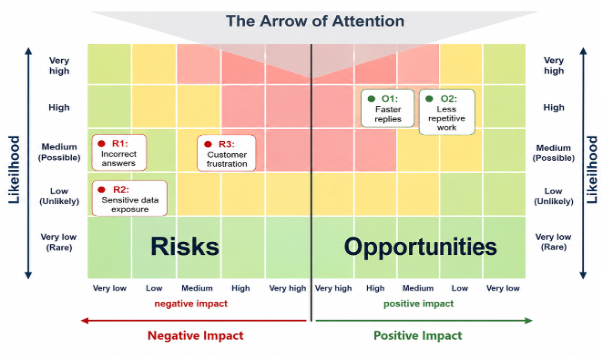
Because the chatbot could improve response times and reduce repetitive work, but incorrect answers and sensitive data exposure remain important risks, therefore the company should begin with a controlled pilot with a route to human support, clear data rules, and regular review.
Review the Full Process
- Identify: What are the main risks and opportunities?
- Assess: How likely and significant are they?
- Plot: Which items deserve the most attention?
- Compare: What options and trade-offs are available?
- Decide: Which response offers an appropriate balance?
- Explain: Why does this option make sense, and under what conditions?
Try It Yourself
Return to your decision from Section A. Use the critical-thinking questions from Section B to examine its assumptions, then complete a small matrix and recommendation using the steps below.
- List the main opportunities and risks; assess likelihood and impact, noting uncertain assumptions.
- Compare possible responses: which benefits, risks, and trade-offs change under each?
- Choose a proportionate response and explain it using Because – But – Therefore – With.
- Name one safeguard and one review trigger: a change that would prompt you to reconsider. Keep these notes as you explore branching rules in Section D.
The matrix has helped you weigh consequences and explain a choice. Section D makes branching questions explicit and tests how well their rules work.