
Rules, patterns, and repetitive behaviors often enhance efficiency, well-being, and goal achievement. It is the overreliance on them that can cause negative effects such as creating a rigid and innovation inhibiting environment. Therefore, it is important to break some of these patterns to adapt to an era of rapid technological change.
Break‑the‑pattern sessions are particularly useful when teams try and find innovative solutions to complex problems and feel stuck in a risk averse mindset or locked into familiar solution paths.
Jeremiah et al. (2025) examined how routines act as both enablers and constraints in a rapidly evolving world and identified several strategies for advancing adaptability and innovation.
Break-The-Pattern Session
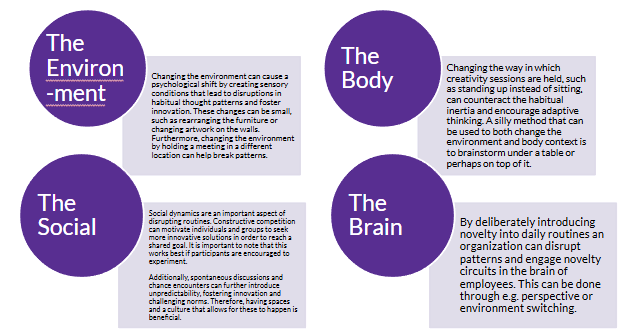
Even though change can lead to innovation, it is critical not to overdo it, as this can overwhelm people and create a sense of instability which can undermine the intended benefits. Jeremiah et al. (2024) found that in the literature, researchers advocate for thoughtful and timed changes. This ensures a balance between having a sense of place and promoting an atmosphere of experimentation and innovation.
Petrou et al. (2020) found evidence that prosocial rule-breaking (1) and obstacles may improve creativity. They further specified that “the literature suggests suggesting that organizations that tolerate deviance are generally more innovative” (Petrou et al., 2020, pp. 186).
- Rule-Breaking
- The paper suggests that managers or organizations should be striving for employees that have a more flexible interpretation of rules. They propose two ways of gaining such employees: 1) seeking employees with this tendency already expressed and 2) create an environment where rule-braking is not punished and creative elements of employee behavior rewarded. The last part can be difficult in practice, as the line between “right” and “wrong” can get blurry.
- Obstacles
- Organizational constraints and obstacles be positively correlated with creativity but intentionally posing obstacles and constraints on employees just to hope for creative solutions, might result in demoralized and exhausted employees. Therefore, the paper refrains from formulating practical implications regarding regulating organizational constraints. But seeing as constraints can aid in creativity, the ASTRAL project recommends that facilitators of workshops think about how constraints on a creativity exercise can help create more innovative solutions.
The key ideas discussed in this section can be summarized as follows:
| Core idea | Description |
| Habit and routine disruption | Interrupting automatic behaviors by changing cues, context, timing, or sequences, creating a “habit discontinuity” window for new actions. For example, force participants to switch mental rules, perspectives, or strategies (e.g., reframing, role‑switching), or change the environment through going somewhere different or moving furniture. This can help by weakening habitual cognition. |
| Rule‑breaking / constructive deviance | Temporarily suspending rules, procedures, or norms to reduce cognitive fixation and increase creative problem solving. |
| Constraint‑based creativity | Introducing artificial constraints (time, resources, materials) to block familiar solutions and force novel combinations. |
| Assumption challenging & inversion | Methods that surface and deliberately reverse hidden assumptions (e.g., “What must be true?”, “What if the opposite were true?”) to unlock new solution spaces. |