
What Is Horizon Scanning?
Horizon scanning is a structured process to identify early signs of change — emerging trends, disruptions, risks, and opportunities — before they become widely recognised.
- Goal: improve preparedness and strategic decision-making under uncertainty, not predict the future with certainty
- Especially critical for SMEs focused on short-term operations that may miss peripheral change
Why It Matters: Organisations that scan the horizon consistently are better positioned to adapt, innovate, and avoid being caught off-guard by disruption.
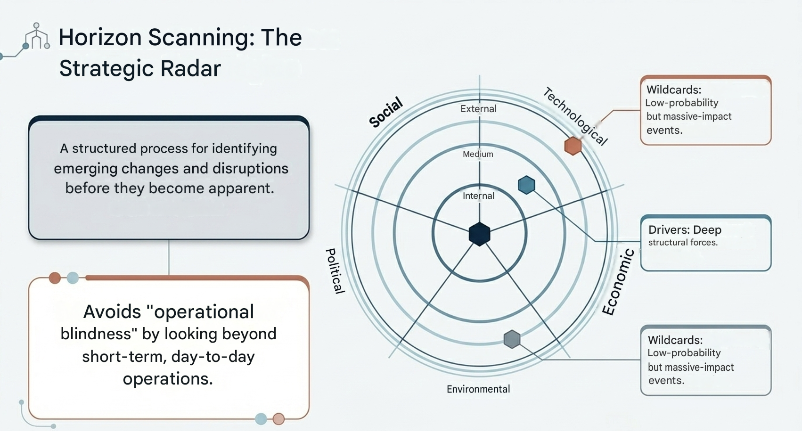
Key Concepts: Signals, Trends & Wild Cards
Signals: Observable indicators of change — new technologies, policy proposals, consumer behaviours, investment patterns
Weak Signals: Early, uncertain, and marginal indicators that may reveal future disruptions before they go mainstream
Trends: Directional patterns that emerge when multiple signals accumulate over time
Wild Cards: Low-probability, high-impact events — pandemics, major cyberattacks — foresight must account for surprising futures
The Horizon Scanning Process
Each stage builds on the previous — defining clear scope ensures scanning efforts remain strategically focused, while continuous monitoring keeps intelligence fresh and actionable.
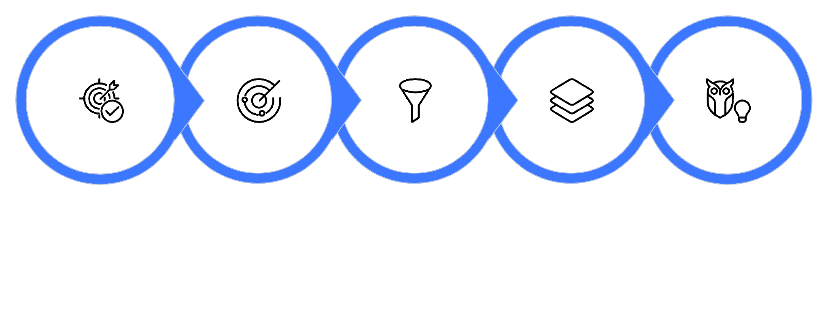
Define Scope -> Scan -> Filter -> Cluster -> Interpret
Building a Scanning Routine
- Daily: Review news, newsletters, and curated feeds
- Weekly: Capture and classify signals in your logbook
- Monthly: Conduct thematic reviews across domains
- Quarterly: Identify emerging trends from clustered signals
- Annually: Update strategic implications for the organisation
Manual Scanning Techniques
Environmental Scanning
Systematic review of external developments across STEEP domains — Social, Technological, Economic, Environmental, Political
Trend Monitoring
Tracking frequency, geographic spread, and investment patterns of directional changes over time
Media & Content Analysis
Identifying new vocabulary, emerging narratives, and shifting public attitudes across channels
Expert Interviews & Delphi
Multi-round structured expert input on uncertain or technical futures — harnessing collective intelligence
Cross-Industry & Peripheral Vision Scanning
Cross-Industry Observation
Disruption often migrates across sectors. Healthcare, for example, adopted efficiency techniques pioneered in aviation safety. What is transforming one industry today may reshape yours tomorrow.
Peripheral Vision
Focus on unusual, marginal developments that may initially seem irrelevant — early crypto communities, AI-generated art, biohacking movements.
Key principle: Weak signals emerge at the margins before entering the mainstream.
Common Mistakes in Horizon Scanning
Focusing only on current trends: Ignore emerging and uncertain developments at your peril
Dismissing weak signals: Small changes can become major disruptions — marginal today, mainstream tomorrow
Over-relying on technology news: Social, environmental, and political signals matter equally and are often overlooked
Treating scanning as prediction: Foresight explores possibilities, not certainties — resist the urge to forecast one outcome
Collecting data without interpretation: Strategic meaning matters more than data volume — analysis, not accumulation, drives insight
Building Your Signal Logbook
A Signal Logbook is a structured repository to record signals, trends, disruptions, and uncertainties. It transforms scattered observations into cumulative strategic intelligence.
Without systematic documentation, valuable insights are forgotten and disconnected from later developments.
Key fields to capture: Signal title · Date · Source · Domain · Potential impact · Time horizon · Uncertainty level · Strategic relevance