
Lesson Description
This module “Strategic Foresight Tools & Methods“ introduces practical strategic foresight tools and methods that help learners identify, analyse, and act on emerging changes. It focuses on real-world application, especially for SMEs, and integrates AI-supported techniques alongside human judgment.
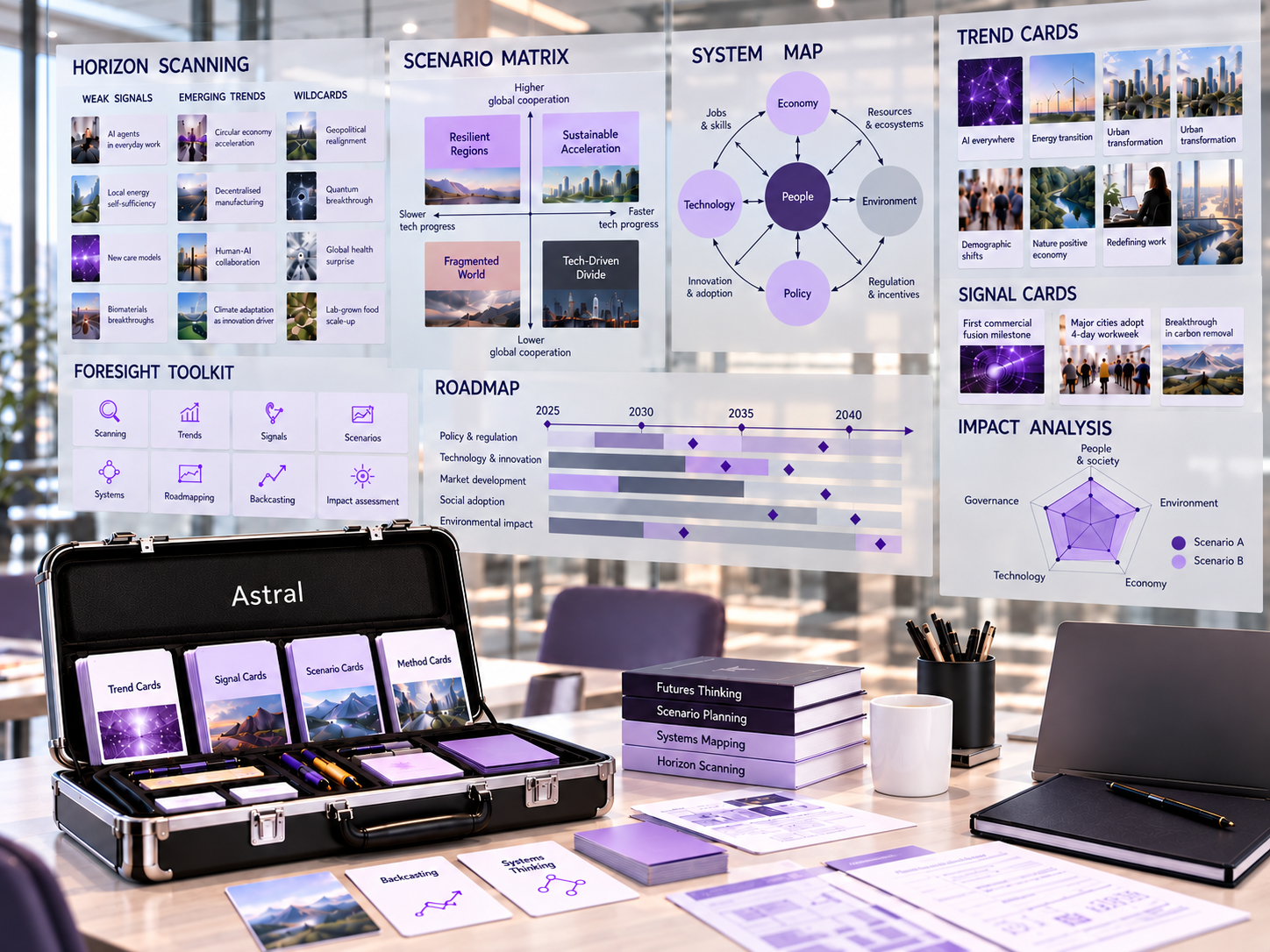
This module provides a practical introduction to the core tools and methods used in strategic foresight.
Learners explore horizon scanning, weak-signal detection, trend and impact mapping, scenario creation, backcasting, and basic systems thinking—all presented through clear, step-by-step guidance. Emphasis is placed on accessibility and real-world application, ensuring that SMEs can apply these methods even with limited time or resources.
The module also introduces AI-augmented foresight techniques, showing how artificial intelligence can support the identification and interpretation of emerging changes. Practical examples illustrate how AI can enhance—but not replace—human judgment in the foresight process.
In this unit you will learn to…
Module 3 reinforces the foundations for everything that follows in the ASTRAL LTFF training program. By the end of this module, you will gain the ability to anticipate change, think strategically about the future, and combine human judgment with AI tools to make better-informed decisions.
By completing this module, you will be able to:
- Apply foresight tools; Use structured methods to analyse signals, trends, and systems.
- Identify weak signals: Detect early signs of change and assess their potential impacts.
- Develop scenarios: Create short future scenarios using both human reasoning and AI-supported insights.
- Generate business insights: Translate signals and trends into actionable, business-relevant insights.
- Use AI-enhanced methods: Apply AI tools for scanning, clustering, and supporting foresight analysis.
- Understand limits of prediction: Distinguish between predictive analytics and long-term foresight, recognising the strengths and limitations of each.
How This Module Is Structured
This module is organised into a structured, step-by-step learning journey that moves from foundational understanding to practical application, with a strong integration of AI-supported methods
The module progresses into Part A: Core Foresight Tools & Methods, which forms the foundation of the learning experience. You are introduced to key foresight techniques in a logical sequence—starting with horizon scanning, followed by weak-signal detection and interpretation, and then moving into trend-to-impact mapping. Building on this analytical base, the module develops more advanced applications such as scenario planning and mini-sprints, before concluding this section with backcasting and systems mapping.
This progression helps you move from identifying signals to developing structured, future-oriented insights.
Building on these foundations, the module transitions into Part B: AI in Foresight, where you explore how artificial intelligence can enhance each stage of the foresight process. This includes AI-supported horizon scanning, AI-driven weak-signal detection, and early-warning systems. The module also introduces the distinction between predictive analytics and long-term foresight, followed by the use of large language models for qualitative sense-making. A dedicated human–AI comparison exercise encourages critical reflection on where AI and human insights align or diverge, reinforcing responsible and effective integration of AI tools.
The learning journey concludes with an assessment and reflection section, where you will apply the knowledge through practical tasks such as scenario development with trend-impact mapping, AI-supported scanning combined with human interpretation, and a reflective exercise on the strengths and limitations of AI in foresight.
To start the course, choose your Lesson and Topic
Course Content
Course Categories: Industry, Industry: Greentech, Industry: Hightech, Industry: ICT, Industry: Mobility, Industry: Other, Industry: other Hightech, Industry: Production, Method: Foresight, Organisation, Organisation: Large Enterprise, Organisation: Other, Organisation: SME, Type: Template