
Scenario Planning: Why Multiple Futures?
In uncertain, rapidly changing environments, single-future predictions are insufficient. Scenario planning develops several plausible futures based on different combinations of trends, drivers, and uncertainties.
Scenarios are not forecasts — they are tools for strategic learning, reflection, and preparedness. Their value lies in expanding what organisations are prepared to consider.
Fundamentals of Scenario Planning
- The future is not fixed — technological, social, economic, and political forces interact in unpredictable ways
- Develop multiple plausible futures, not a single prediction — resist the temptation of false certainty
- Identify drivers of change (STEEP) and critical uncertainties that create different future pathways
- Apply systems thinking — changes in one area affect many others across the organisation and sector
- Use a long-term perspective: medium horizon (≈10 years) and long-term horizon (20+ years)
What Makes a Good Scenario?
Plausible
Grounded in real trends and drivers — not fantasy, but credible futures
Evidence-Informed
Supported by data, signals, and trend analysis — not speculation alone
Internally Consistent
Elements of the scenario do not contradict each other — the narrative holds together
Strategically Relevant
Directly connected to the organisation’s key questions and decision contexts
The value lies in the thinking process as much as in the scenarios themselves.
What Is a Mini-Sprint?
A Focused Foresight Method
A mini-sprint is a short, intensive, collaborative process to rapidly analyse a problem, explore future possibilities, and develop strategic responses. Inspired by agile and design-thinking — adapted for foresight and forecasting contexts.
Key Characteristics
- Short Duration
- High Focus
- Team-Based
- Structured
- Exploratory
- Action-Oriented
Running a Mini-Sprint: 7 Stages
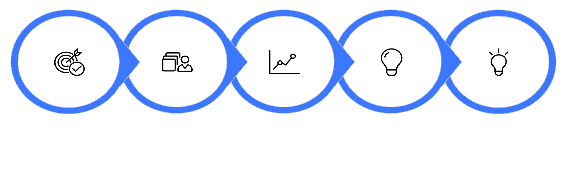
Define -> Gather -> Trends -> Explore -> Generate
The mini-sprint structure ensures teams move from ambiguous challenges to concrete strategic outputs in a single focused session — maintaining momentum without sacrificing analytical rigour.
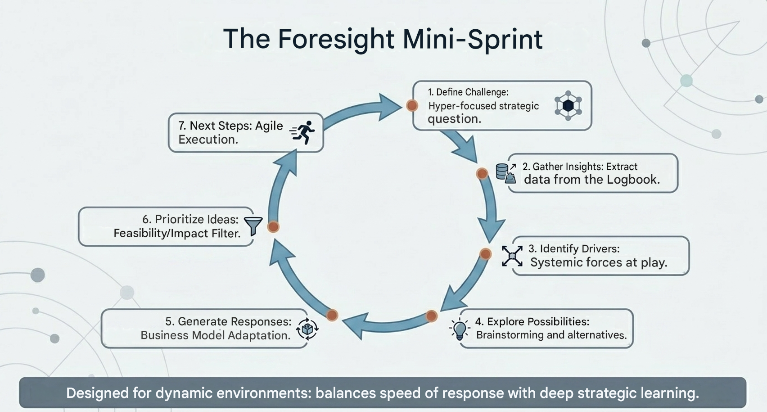
Mini-Sprint in Action: Retail & AI
Challenge
“How could AI influence customer experience in retail over the next five years?”
Drivers Identified
Automation · Data analytics · Personalisation technologies — converging forces reshaping the retail landscape
Future Possibilities
Fully automated shopping · AI-driven recommendations · Ethical concerns over customer data privacy
Strategic Responses
Invest in AI literacy · Develop ethical AI policies · Experiment with personalised service offerings
Enriching Scenarios with Trend-Impact Data
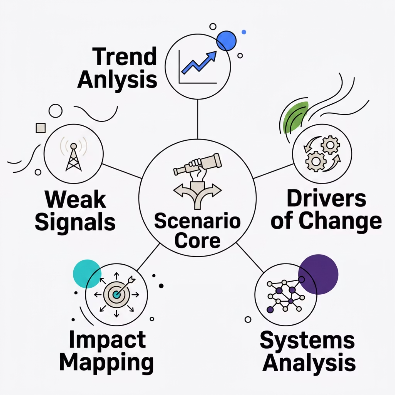
Scenarios become more valuable when supported by evidence, structured analysis, and trend-impact data. Enrichment transforms basic narratives into robust strategic tools.
What Enriched Scenarios Integrate
Systems analysis and feedback loops
Trend analysis and signal clusters
Impact mapping across domains
Weak signals and early indicators
Drivers of change and critical uncertainties