
Backcasting: Working Backwards from a Desired Future
Unlike forecasting (projecting forward from the present), backcasting starts with a desired future state and works backwards to identify the steps needed to reach it.
When to Use Backcasting
- Long-term strategic planning
- Sustainability goals and net-zero roadmaps
- Innovation and transformation roadmaps
The Core Question: What must change today — in strategy, capabilities, partnerships, and culture — to achieve a preferred tomorrow?
Systems mapping
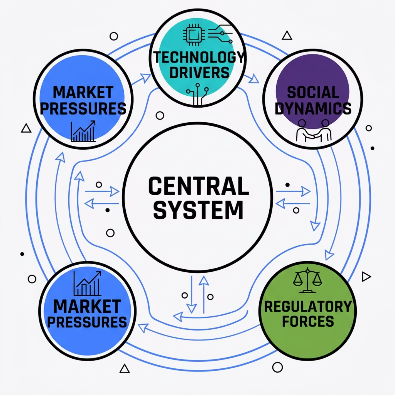
What Is Systems Mapping?
Systems mapping visualises the relationships and feedback loops between factors influencing a system — helping organisations understand complexity, interdependence, and unintended consequences.
Key Tools
- Causal loop diagrams
- Miro / FigJam collaborative boards
- Influence maps
Effective foresight combines structured observation, critical interpretation, and systems awareness.
What Is Systems Mapping?
A foresight method for understanding complex, interconnected, and dynamic problems that shape long-term futures.
Feedback & Emergence
Aids in thinking about feedback loops, emergent behaviours, and interactions between actors — individuals, organisations, nature, cities, forces.
Strategic Anticipation
Supports strategic anticipation by revealing how technological, social, economic, and environmental factors interact over time.
Why Systems Thinking Matters
Interconnected World
The world is increasingly interconnected — solving problems in one area can have detrimental effects on another.
Multi-Variable Drivers
Long-term developments are seldom driven by single variables.
Imperative for LTFF
A systems thinking mindset is imperative for Long-Term Future Foresighting (LTFF).
Conceptual Foundation: What Is a System?
“A system is an interconnected set of elements that is coherently organised in a way that achieves something.” — Meadows, 2008
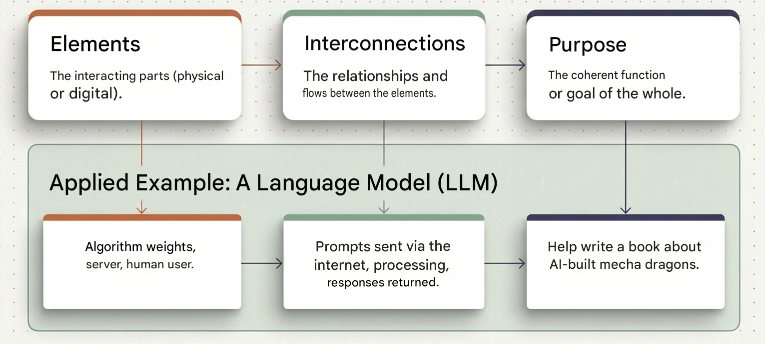
Identifying a System: Key Questions
If all answers are “yes”, you can map the system.
- 1 Can you identify elements? If yes, what are they?
- 2 Do the elements affect each other? If yes, how do they interact?
- 3 Do elements together produce a different effect? Different from each element alone?
- 4 Does the effect persist over time? In different circumstances?
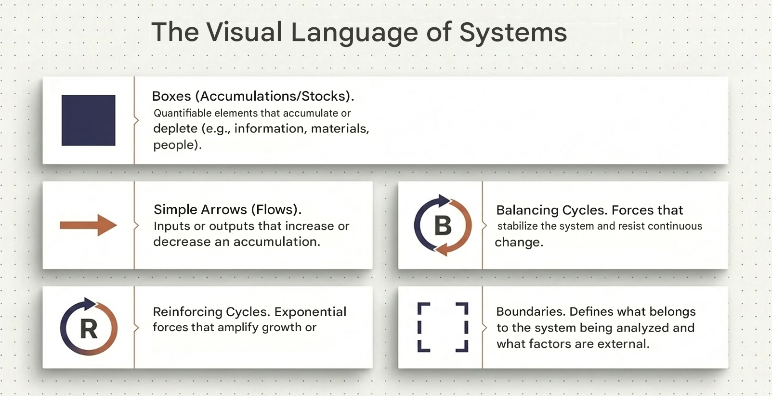
Constructing a System Map: Core Components
Example: Platform User Base
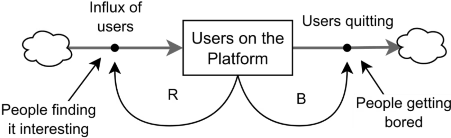
Stock
Number of users on a platform
Inflow
New users joining because they find it interesting
Outflow
Users quitting because they find it boring
R Loop
More users → more word-of-mouth → more new users
B Loop
Users exploring → getting bored → quitting
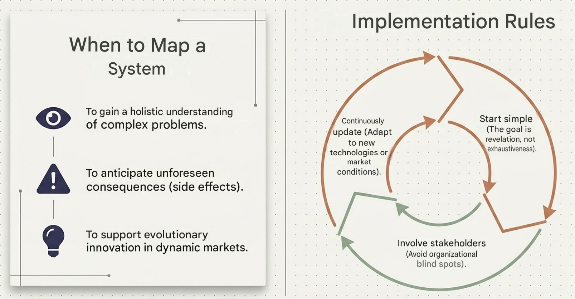
When to Apply Systems Mapping
Holistic Understanding
Gain a deep understanding of a specific area
Detect Consequences
See how changes could affect a specific area — especially to detect negative consequences elsewhere
Unexpected Outcomes
Understand why a solution works in unexpected ways
Causal Relationships
Identify feedback loops, not just list factors
Support Innovation
Understand how markets, technologies, and customer needs evolve and influence each other
Notes on Systems Mapping: Practical Guidance
Start Simple
Iteratively refine — begin with a focused question (e.g. “How can we scale sustainably?”)
Insight, Not Completeness
It is impossible to map the entire system — the goal is insight.
A Living Tool
Update when market conditions change, new technologies emerge, or strategic priorities evolve.
Facilitation Required
Requires facilitation and stakeholder engagement to avoid blind spots.
Systems Mapping Toolkit
Tools
Miro, FigJam, draw.io, PowerPoint, or pen and paper
Stock (Box)
Represents an element or accumulation in the system
Arrow
Indicates a flow from one stock to another
Feedback Loop Arrow
B = balancing, R = reinforcing; use + / − to show direction of effect
Brackets
Show system boundaries — incoming or outgoing flows
Download
Find this topic as a downloadable resource here