
Testing theories and models about how to create value is essential to ensure efficient use of resources and continued growth. Therefore, rapid experimentation should be part of every organization.
In short, rapid experimentation is an innovation approach in which organizations build simplified versions of products, services, or business‑models to test assumptions with real users. Through this, organizations quickly gain information on whether their idea would work or not (validation), allowing them to not waste resources on a bad idea (fail fast). Rapid experimentation allows for quick:
- Exploration of uncertainty through action rather than analysis
- Risk and uncertainty minimization
- Collection of real data on customer behavior and/or preferences
Lean Startup
In a business context, teams can use rapid prototyping by first articulating explicit assumptions (e.g., about customer needs, value propositions, or usage patterns) and design prototypes that allow these assumptions to be tested quickly. A method for testing business models quickly is the Lean Startup method. This is one of the most widely embraced entrepreneurial methods.
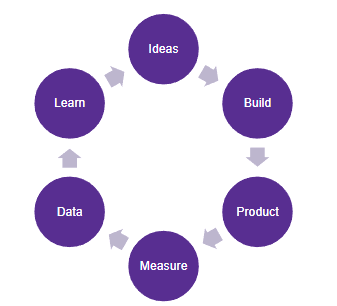
The lean startup method consists of two significant features: 1) formulate hypotheses about the different key areas of the business model, and 2) probe each hypothesis by customer and stakeholder interaction e.g. conducting interviews or testing it with the use of a prototype landing page. With the experience gained through the first round, subsequent hypotheses testing round can be made if needed. By doing this iterative hypothesis probing, the idea is to converge on a viable business idea.
Leatherbee and Katila (2020) found that probing the costumers in lean startup not only motivates convergence on business ideas, it also allows for new ideas and hypotheses to emerge that can be tested. They further found that formal business educated practitioners tend to resist the method, but that those who use it tend to formulate more business ideas and hypotheses and converge on a business idea faster than those without formal education.
Potential pitfalls of the lean startup method have been formulated by Felin et al. (2020). They argue that the lean startup approach promotes incremental experiments due to is reliance on readily observable feedback and immediate validation. This promotes searching for validation and value only in easily observed and tested areas. Therefore, it is important to reflect on when and where to use the lean startup method as for radical innovation, costumers seldom know what they want.
A quote often attributed to Henry Ford describes this phenomenon well: “If I had asked people what they wanted, they would have said faster horses.” (Quoteresearch, 2011)
Lean Startup cycle based on Eric Reis (2011)
The following table layes out some methods for rapid experimentation:
| Technique | Description | Source(s) |
|---|---|---|
| Wizard of Oz or Mechanical Turk | This method is about replacing complex mechanical parts with humans. An example would be IBM who tested speech to text in 1984 with the use of a microphone with a user and an experience typist in another room to simulate the scenario of speech to text. | (Savoia, 2022), (Buchenau & Suri, 2000) |
| Pinocchio | This method consists of building a dummy or nonfunctional version of a potential product. With the use of your imagination, the product can be experienced and experimented with. | (Savoia, 2022), (Buchenau & Suri, 2000) |
| The Fake Door | In this method, you create a fake “door” to your product or service. This can be in the form of e.g. a landing page to collect information on how many are interested in what you offer. | (Savoia, 2022) |
| Minimal Viable Product | The Minimal Viable Product comes from lean startup. It is the simplest version of a product that delivers enough value to solve a core user problem. Its purpose is to quickly test assumptions and gather real user feedback with minimal time and resources invested. By launching an MVP early, teams can learn what works, avoid building unnecessary features, and iteratively improve the product based on evidence rather than guesses. | (Ries, u.d.) |
| A/B testing | A/B testing is a method of comparing two or more versions of a product element to see which performs better. This can be a feature, design, or message. Users are split into groups and shown different variants, with outcomes measured against a clear metric (e.g., conversions or engagement). This approach helps teams make data‑driven decisions, reduce guesswork, and continuously optimize products based on real user behavior. Konning et al. (2019) found that A/B testing is associated with scaling and failing faster, meaning fewer resources are wasted. | (Konning et al., 2019), (Quin et al., 2024), (Bojinov & Gupta, 2022) |
References
- Beausoleil, A. (2022, February). How to use storyboarding techniques to solve complex business problems. Retrieved from Insight Hub: https://www-2.rotman.utoronto.ca/insightshub/creativity-innovation-business-design/Design_thinking_storyboards
- Bojinov, I., & Gupta, S. (2022). Online Experimentation: Benefits, Operational and Methodological Challenges, and Scaling Guide. Harvard Data Science Review, 4(3). https://doi.org/10.1162/99608f92.a579756e
- Buchenau, M., & Suri, J. F. (2000). Experience prototyping. In W. A. Kellogg & D. Boyarski (Eds.), Proceedings of the 3rd Conference on Designing Interactive Systems: Processes, Practices, Methods, and Techniques (pp. 424–433). ACM. https://doi.org/10.1145/347642.347802
- DTU Skylab. (n.d.). Bodystorming. Retrieved from DTU Universal Design Guide: https://universaldesignguide.com/method/bodystorming/#consider
- Ries, E. (2011). The lean startup : how constant innovation creates radically successful businesses. Portfolio/Penguin.
- Felin, T., Gambardella, A., Stern, S., & Zenger, T. (2020). Lean startup and the business model: Experimentation revisited. Long Range Planning, 53(4), Article 101889. https://doi.org/10.1016/j.lrp.2019.06.002
- Google. (n.d.). Crazy 8’s. Retrieved from Design Sprints: https://designsprintkit.withgoogle.com/methodology/phase3-sketch/crazy-8s
- Guthrie, G. (2022, January 15). The lotus blossom technique: a creativity hack you need to know. Retrieved from nulab.com: https://nulab.com/learn/design-and-ux/the-lotus-blossom-technique-creativity-hack-you-need-to-know/
- Hagen, M., Bernard, A., & Grube, E. (2016). Do It All Wrong! Using Reverse-Brainstorming to Generate Ideas, Improve Discussions, and Move Students to Action. Management Teaching Review, 1(2), 85–90. https://doi.org/10.1177/2379298116634738
- Hampshire, N., Califano, G., & Spinks, D. (2022). Mastering Collaboration in a Product Team : 70 Techniques to Help Teams Build Better Products (1st ed. 2022.). Apress. https://doi.org/10.1007/978-1-4842-8254-0
- Higgins, J. M. (1996). Innovate or evaporate: Creative techniques for strategists. Long Range Planning, 29(3), 370–380. https://doi.org/10.1016/0024-6301(96)00023-4
- Jeremiah, F., Butson, R. & Oke, A. (2025). New perspectives on repetitive behaviour. Psychological Research 89(2), Article 61. https://doi.org/10.1007/s00426-025-02092-6
- Koning, R. M., Hasan, S., & Chatterji, A. (2019). Experimentation and Startup Performance: Evidence from A/B testing. NBER Working Paper Series, 26278. https://doi.org/10.3386/w26278
- Leatherbee, M., & Katila, R. (2020). The lean startup method: Early‐stage teams and hypothesis‐based probing of business ideas. Strategic Entrepreneurship Journal, 14(4), 570–593. https://doi.org/10.1002/sej.1373
- Petrou, P., Linden, D., & Salcescu, O. C. (2020). When Breaking the Rules Relates to Creativity: The Role of Creative Problem‐Solving Demands and Organizational Constraints. The Journal of Creative Behavior, 54(1), 184–195. https://doi.org/10.1002/jocb.354
- Quin, F., Weyns, D., Galster, M., & Silva, C. C. (2024). A/B testing: A systematic literature review. The Journal of Systems and Software, 211, Article 112011. https://doi.org/10.1016/j.jss.2024.112011
- Quoteresearch. (2011, July 11). Quote Origin: My Customers Would Have Asked For a Faster Horse. Retrieved from Quote Investigator: https://quoteinvestigator.com/2011/07/28/ford-faster-horse/
- Ries, E. (n.d.). What is an MVP? Retrieved from Lean Startup Co.: https://leanstartup.co/resources/articles/what-is-an-mvp/
- Savoia, A. (2022). Pretotype It 10th Anniversary Edition. PretotypeLabs.
- University College Dublin. (2020, April 21). Agile guide to – Reverse brainstorming with antisolutions. Retrieved from University College Dublin: https://www.ucd.ie/agile/resources/agileguideto-reversebrainstormingwithantisolutions/
- Wilson, C. E. (2007). Inverse, reverse, and unfocused methods: variations on our standard tools of the trade. Interactions, 14(6), 54–ff. doi:https://doi.org/10.1145/1300655.1300687
Read More Here
- Original book on lean startup
- Ries, E. (2011). The lean startup : how constant innovation creates radically successful businesses. Portfolio/Penguin.
- Find the Pretotype it book here: