Commercialization Strategies
Several commercialization strategies exist for innovations. This section of Module 5 will first go through internal and external strategies to capture value from innovations. Thereafter, it will go through the commercialization model made by Gans and Stern (2003) which aids startups and SMEs to identify possible strategies of commercialization.
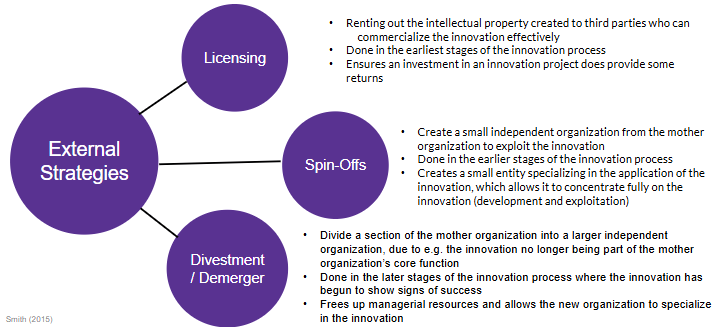
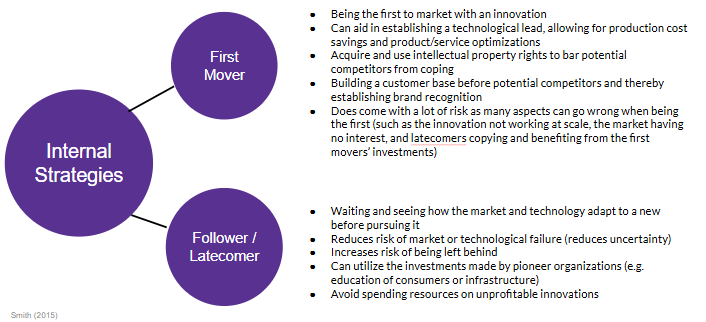
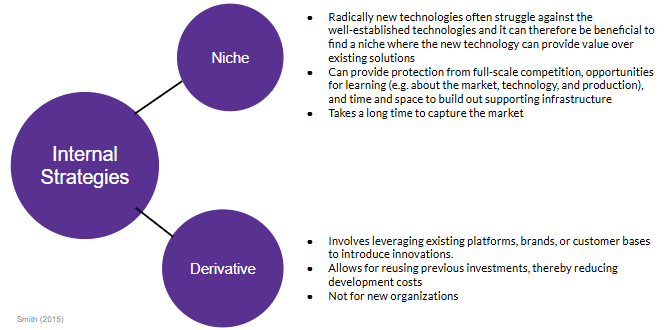
Two overarching strategies for innovations exist – internal and external. The most important question to ask before choosing a strategy is if your company should enter the market with its innovation or not. If the answer is “yes”, then you should go for internal strategies, and if “no”, then external strategies are appropriate. Internal strategies focus on market entry timing and positioning, while external strategies focus on alternative mechanisms for value capture without direct market entry. External routes to capture value from innovation can be exceptionally valuable and be caused by many factors. An organization can lack the resources, reach, and/or knowledge to carry the innovation to market. Additionally, the innovation could be a poor fit for the organization’s strategy.
Commercialization Strategies – Complementary Assets
To understand the commercialization model by Gans and Stern, a prerequisite is the grasp of complementary assets. These are in short, all assets that are not related to the innovation at hand (Teece, 1986). This can be seen as some form of scaffolding for the innovation, its supporting infrastructure. Teece (1986) researched which factors determined the winner in the race of innovation, and identified three type of assets (1 generic and 2 complementary) which impacted this:
- Generic Assets
- Are assets that do not need to be specialized to the innovation
- Example: A generic asset could be access to servers (GPU/CPUs and data storage). Servers are readily available for anyone to rent or buy.
- Specialized Assets
- Are when the complementary asset is dependent on the innovation and vice versa
- Example: A bespoke semiconductor fabrication mask for a novel chip architecture could be seen as a specialized asset due to the tooling being useless without the specific product.
- Cospecialized Assets
- Are when the complementary assets and the innovation are dependent on each other
- Example: A cospecialized asset could be quantum hardware since it requires custom control software and algorithms to work properly. The hardware and software co‑evolve and have little value independently.
| Asset Type | Dependency Structure | Strategic Importance |
| Generic | Low / none | Easy to contract; rarely decisive |
| Specialized | One‑way (asset → innovation or innovation → asset) | Creates hold‑up risks; often favors integration |
| Cospecialized | Two‑way (asset ↔ innovation) | Critical for value capture and long‑term advantage |
Commercialization Strategies – Commercialization Model
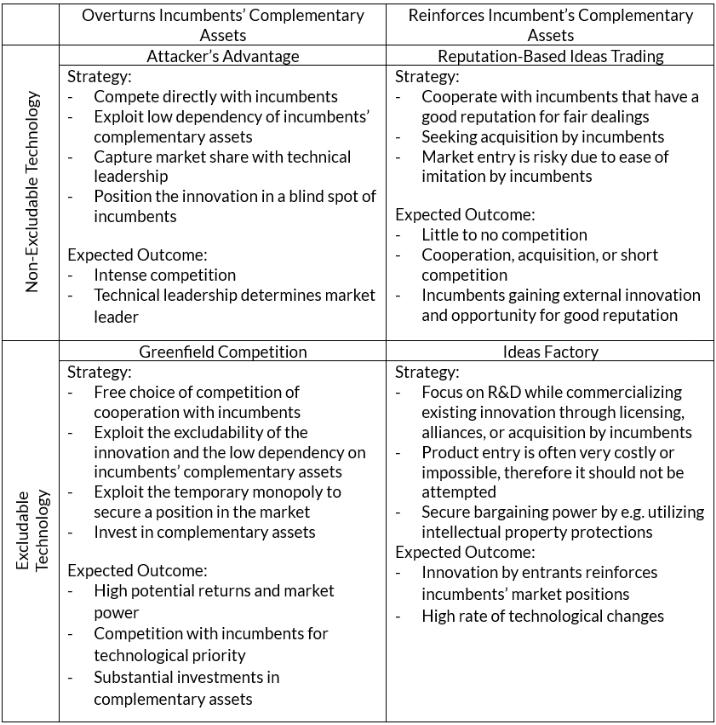
The type and ownership of complementary assets strongly influence which commercialization strategies are feasible and attractive. Gans and Stern (2003) identified four strategies that startups can employ to gain value from their innovations. Even though the model has been made with startups in mind, SMEs can also find it useful as many of the aspects of the model applies to them as well.
The commercialization model matrix differentiates based on two parameters: if the innovation reinforces or overturns incumbents’ complementary assets and the innovation is excludable or not. The excludability of an innovation refers to if the organization can preclude incumbents from developing similar technologies. This can be done through intellectual property and other complementary assets which bars entry of incumbents.
Choosing a commercialization strategy can be hard, and we therefore recommend to first take a critical look on your innovation and what assets are needed for it to be actualized. Thereafter, a thorough analysis of your companies complementary and generic assets should be done to identify opportunities and lacking aspects. An organization seldom fall exactly into one of the four categories and many firms move between quadrants over time as excludability and asset needs change. The model can give indications of possible strategies to peruse.