
Structural Blueprint of the Risk Management & Governance Program
An effective high-tech SME innovation governance program consists of four interconnected operational layers:
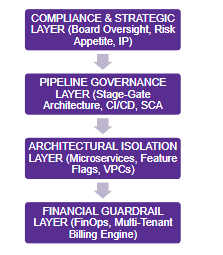
1. Compliance & Strategic Layer (Teece, 2007)
Corporate governance begins by establishing formal classification models to manage asset protection and risk tolerance
- Granular Asset Decoupling: Intellectual property (IP) is systematically audited and categorized into two distinct buckets: Core Proprietary Assets (e.g., proprietary algorithms and foundational models) and Peripheral Functional Modules (e.g., integration APIs and interface code). This allows open innovation initiatives to occur on peripheral elements while securing the core codebase
- Technical Risk Appetite Statements (RAS): The executive board defines precise, quantifiable limits for technological risk. These metrics outline the acceptable volume of non-critical technical debt permitted during exploratory research sprints, bound by mandatory targets for system downtime and recovery latency
2. Pipeline Governance Layer (Albats et al., 2023)
To maintain development velocity, traditional administrative milestone reviews are translated into automated software supply chain controls
- Automated Stage-Gate Enforcement: Mandatory compliance rules are integrated directly into the continuous integration (CI) pipeline. Code submissions are systematically blocked from entering the main codebase until they clear automated unit testing, code linting, and vulnerability scanning
- Software Composition Analysis (SCA): Automated license-compliance scans run continuously across the development environment to flag and restrict the introduction of third-party libraries with copyleft or non-commercial licenses, preventing intellectual property contamination
3. Architectural Isolation Layer (Tiwana & Konsynski, 2010)
System engineering architectures are designed to match corporate risk-containment strategies, minimizing blast radiuses during radical innovation phases
- Decoupled Microservice Isolation: Exploratory features and experimental updates run in structurally isolated microservices or containerized infrastructure, preventing dependencies from impacting production platforms
- Dynamic Feature Toggle Controls: Speculative product features are wrapped in runtime routing flags. This gives engineering teams the ability to instantly decouple or deactivate malfunctioning or insecure components in production without requiring system redeployments or rollbacks
- 4. Financial Guardrail Layer
Infrastructure management and value capture mechanisms are protected against unexpected operational anomalies during strategy implementation & commercialization
- FinOps Cost Optimization Controls: Cloud infrastructure utilization is monitored in real time using automated budget tracking. Automated threshold monitors generate rapid alerts when speculative computational paths create unexpected surges in database or cloud hosting costs
- Decoupled Multi-Tier Billing Infrastructure: Value-capture mechanisms are managed through isolated, transactional data ledgers. This enables the parallel tracking of legacy contract metrics alongside new consumption metrics, ensuring complete financial auditability
References
Gans, J. S., & Stern, S. (2003). The product market and the market for “ideas”: commercialization strategies for technology entrepreneurs. Research Policy, 32(2), 333–350. https://doi.org/10.1016/S0048-7333(02)00103-8
Smith, D. (2015). ‘Chapter 6 Value Capture’ and ‘Chapter 8 Innovation Strategy’ in Exploring innovation (3. edition.). McGraw-Hill Education, pp. 115-130 and pp. 153-176.
Teece, D. J. (1986). Profiting from technological innovation: Implications for integration, collaboration, licensing and public policy. Research Policy, 15(6), 285–305. https://doi.org/10.1016/0048-7333(86)90027-2