
Explore how technology affects well-being by changing work demands, control and support.
Concepts to understand before starting this lesson
Well-being
A person’s ability to work, adapt, participate, and cope with change in a healthy and sustainable way.
Foresight
A structured way to explore possible futures and make better decisions today.
Job demands
The pressures a job places on people, such as workload, pace, complexity, interruptions, or emotional strain.
Job resources
The support people have, such as autonomy, clarity, training, social support, and useful tools.
Why This Topic Matters
Technology decisions often focus on efficiency, cost, speed, or innovation.
But future strategies also change how people work.
A new system can:
- increase pace;
- change roles;
- reduce or improve control;
- make work clearer or more stressful;
- support learning or overload people;
- strengthen trust or weaken it.
Key idea
A strategy may look successful on paper but still fail in practice if it damages people’s ability to work well over time.
Main message of this lesson:
Technology affects well-being mainly by redesigning work.
There Are Many Ways to Look at Well-being and Technology
There is not only one theory for understanding how technology affects well-being.
Researchers have approached this issue in different ways, including:
Socio-technical systems theory
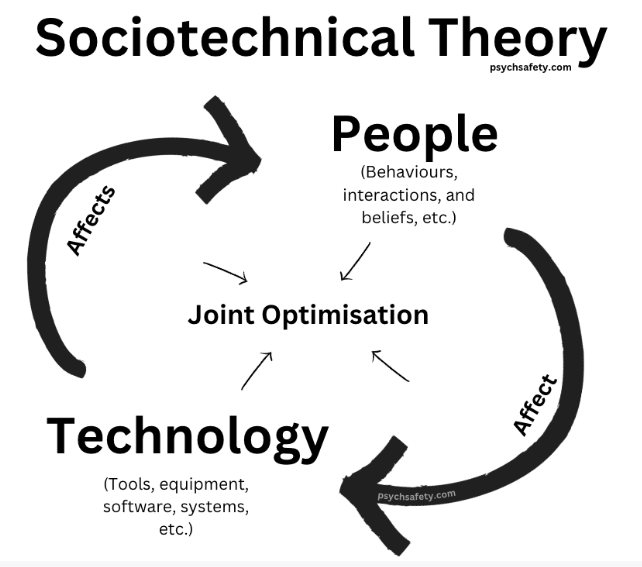
- Technology and the social organisation of work must be designed together.
Job Demand–Control theory
- Stress is more likely when job demands are high and control is low.
Job Demands–Resources theory
- Well-being depends on the balance between demands and resources.
Other useful perspectives
- Digital well-being and motivation research
- Technostress research
- Self-Determination Theory

Key idea
For this lesson, we will focus on these three core theories as they are the most practical for foresight and action planning.
Start by looking at the technology and the organisation of work together.
Theory 1: Socio-technical Systems Theory
Main idea
Technology should never be viewed as a separate technical layer.
When an organisation introduces a new technology, it also changes:
- how much support they receive.
- how work is divided;
- how people coordinate;
- how much flexibility they have;
- how much variety and meaning their work contains;
What this theory tells us
A technology decision is also a work-design decision.
If the technical system changes but the social system is ignored, the result may be:
- lower autonomy;
- less variety in work;
- reduced feedback;
- weaker collaboration;
- poorer well-being.
Simple learner takeaway:
Do not ask only: “What can this technology do?”
Also ask: “What kind of work system does this technology create?”
Within that work system, the balance between pressure and control helps explain strain.
Theory 2: Job Demand–Control Theory
Main idea
People experience more strain when their work has: high demands + low control
Examples of job demands
- tight deadlines
- constant alerts
- complex decisions
- many interruptions
- emotional pressure
- fast response expectations.
Examples of control
- freedom to choose how to work
- ability to prioritise tasks
- chance to question or override a system
- time to recover or pause
- influence over scheduling.
What this theory tells us
A technology may improve efficiency but still reduce well-being if it:
- forces people into rigid workflows.
- speeds up work too much;
- increases monitoring;
- reduces discretion;
Simple learner takeaway:
A future strategy becomes risky when it adds pressure but takes away control.
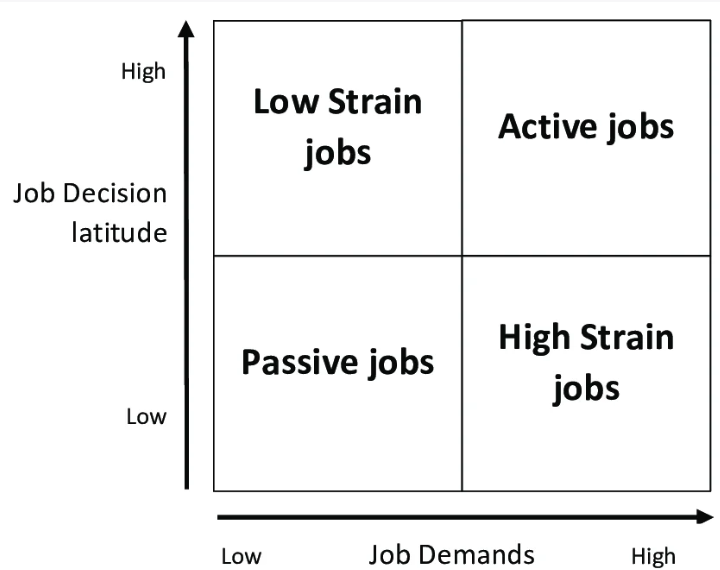
Control is one resource. The next theory widens the lens to the other support people need.
Theory 3: Job Demands–Resources Theory
Main idea
Well-being depends on the balance between:
Job demands(what drains energy) ←→ job resources (what supports people)
Common job demands
- work overload;
- time pressure;
- constant change;
- learning pressure;
- role ambiguity;
- digital interruptions.
Common job resources
- autonomy;
- role clarity;
- feedback;
- supportive leadership;
- training;
- good tools;
- peer support.
What this theory tells us
Technology does not affect well-being in one fixed way.
The same system may:
- create stress later if support is missing.
- increase demands for one group
- create useful resources for another group
- improve performance at first
Simple learner takeaway:
The best foresight question is not: “Is this technology good or bad?”
It is: “Does it increase demands, reduce resources, or create new resources?”
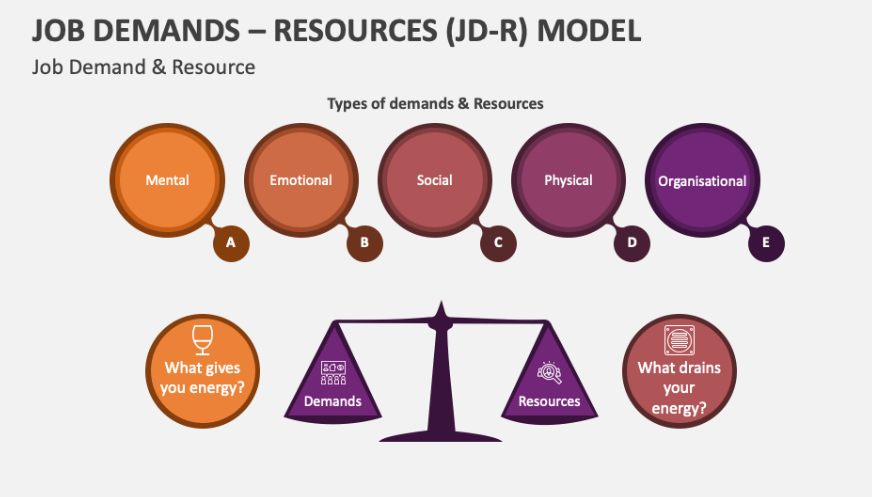
Two supporting perspectives help explain the pressures and needs behind these theories.
Supporting Perspectives: Technostress and Psychological Needs
In addition to the three core theories, two other perspectives are useful:
Technostress
Technology can create stress through:
- overload;
- complexity;
- constant connectivity;
- frequent change;
- monitoring;
- unclear expectations.
Psychological Needs
People tend to function better when technology supports:
- Autonomy — feeling some choice and control
- Competence — feeling capable and able to learn
- Relatedness — feeling connected, supported, and respected
Key idea
Even a useful technology can damage well-being if it creates overload, weakens autonomy, or makes people feel unsupported.
Together, the theories connect technology decisions with the experience of work.
What All Three Theories Tell Us
Although the theories use different language, they point to the same practical insight:
Technology affects well-being through work design
A future strategy may change:
- the pace of work;
- the amount of control people have;
- the support available to them;
- the meaning and variety of work;
- their opportunity to learn;
- their ability to recover and adapt.
Core foresight question
What kind of work experience does this future create?
This is the key question for integrating well-being into foresight.
These theories explain what to look for. Next, use the Technology–Well-being Pathway Map to trace the effects of a digital task-management platform.