
Ecosystem mapping tells you where you are. Strategic positioning tells you where you could go. But an organisation also needs to know where it wants to go — and why that direction matters enough to pursue together. That is what shared long-term visions are for.
Why Individual Foresight Is Not Enough
Every person in an organisation has a view of the future — whether they articulate it or not. The sales director believes the market will shift to service-based models. The operations lead expects supply chains to regionalise. The technical team sees AI automation as inevitable.
Each perspective is valuable — but also partial, siloed, and often mutually inconsistent. When unshared, the organisation ends up pursuing multiple implicit futures simultaneously: individually rational but collectively incoherent.
What Shared Visioning Does
- Surfaces individual views and makes them explicit
- Aligns where possible; holds tensions where they genuinely exist
- Produces a collective direction richer than any single perspective
- Creates alignment, shared ownership, and adaptive capacity
Organisations that invest in shared visioning consistently outperform those that don’t — not because the vision is always accurate, but because the process creates alignment.
Vision vs. Forecast vs. Scenario
| Vision | Forecast | Scenario | |
|---|---|---|---|
| What it is | A chosen direction — what we want to work towards | A projection based on current trends | A plausible future under different conditions |
| Based on | Values, ambition, and strategic choice | Data, models, extrapolation | Assumptions, drivers, and uncertainties |
| Certainty | Does not claim to predict. Claims to guide. | Claims probabilistic accuracy | Explicitly acknowledges uncertainty |
| Role | Provides direction and motivates commitment | Informs short-term planning | Expands futures considered; stress-tests strategies |
A shared vision does not require certainty about the future. It requires clarity about what you are choosing to pursue — and collective commitment to pursue it together.
Four Stages: From Individual to Collective Vision
Stage 1: Surfacing
Individual views of the future are made explicit — spoken aloud, written down, and shared. Hidden assumptions become visible. Failure risk: people share only what is expected, not what they genuinely believe.
Stage 3: Synthesising
Common ground is identified and named. Genuine tensions are acknowledged and held, not smoothed over. Failure risk: dominant voice imposes a synthesis; quieter participants feel unheard.
Stage 2: Listening
Participants genuinely engage with each other’s views — not to debate, but to understand. Differences are mapped, not resolved. Failure risk: the group slides into debate rather than understanding.
Stage 4: Committing
The group agrees on a shared direction — not because everyone agrees on every detail, but because there is enough common ground to commit to a collective journey. Failure risk: vision produced as document but not internalised.
What Makes a Good Shared Vision?
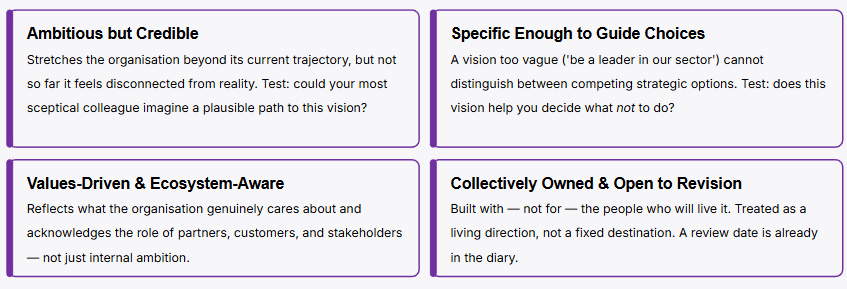
Case Example: A Vision That Changed Decisions
A 28-person logistics technology company in Denmark was repeatedly caught in short-term firefighting. In a facilitated half-day visioning session with six participants from across the company, the group built a shared direction: “By 2033, the most trusted logistics intelligence partner for mid-market retailers in Northern Europe — not the largest, not the cheapest, but the most trusted.”
The specificity of ‘mid-market retailers’ and ‘Northern Europe’ immediately ruled out certain strategic options and validated others. In the 18 months following, the company made three significant decisions — a technology partnership, a pricing restructure, and a geographic expansion — all evaluated against the shared vision. Two of the three would have been decided differently without it.
The Five Phases of Facilitated Visioning
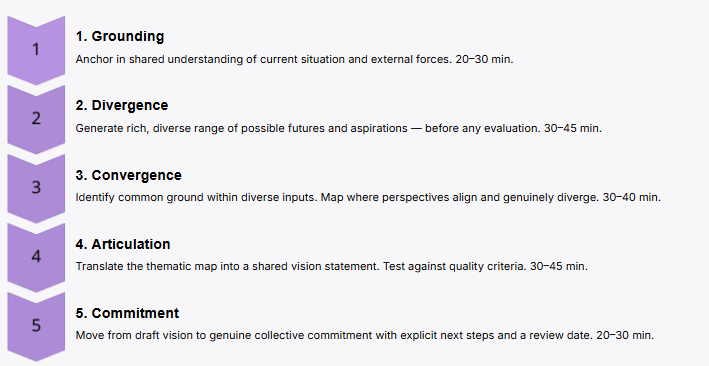
The Five Phases of Facilitated Visioning
1. Grounding
Anchor in shared understanding of current situation and external forces. 20–30 min.
2. Divergence
Generate rich, diverse range of possible futures and aspirations — before any evaluation. 30–45 min.
3. Convergence
Identify common ground within diverse inputs. Map where perspectives align and genuinely diverge. 30–40 min.
4. Articulation
Translate the thematic map into a shared vision statement. Test against quality criteria. 30–45 min.
5. Commitment
Move from draft vision to genuine collective commitment with explicit next steps and a review date. 20–30 min.
Never skip Phase 5. The commitment phase is what transforms a good conversation into a shared strategic direction.
Three Proven Visioning Techniques

Future Day Narrative
Each participant writes a short narrative: ‘It is [target year]. Describe a typical working day.’ Unlocks imagination and helps people feel the future rather than just think it. Particularly powerful with groups who find abstract strategic language difficult.

Newspaper Front Page
Each participant writes a front-page story about their organisation in the target year: headline, three-sentence summary, and a customer quote. Gives people permission to be more ambitious than in conventional strategy conversations.

Value Constellation
Participants independently select their top 5 values from 40 options. The most-selected words form the vision’s value foundation. Especially effective for ecosystem-level visioning that involves partners.
Keeping the Vision Alive After the Session
Circulate Within 48 Hours: Send the completed Shared Vision Canvas to all participants and decision-makers not in the room. The first circulation signals this is a real organisational document.
Make It Visible: Post the vision statement where the team regularly sees it — a meeting room wall, a pinned message in a team channel, or the header of your internal weekly update.
Reference It in Decisions: For the next three months, whenever a significant decision arises, ask explicitly: ‘How does this choice connect to our shared vision?’
Review at 6 & 12 Months: Set a calendar event now. At 6 months: has the external context changed? At 12 months: full canvas review. What has been accomplished? What needs to change?
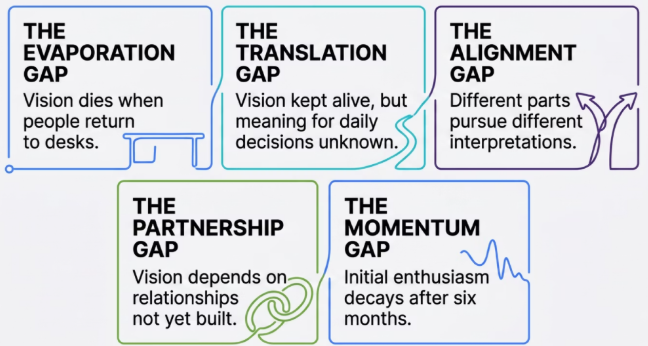
Turning Vision into Joint Action
Research consistently identifies the same pattern: the organisations best at generating strategic visions are not necessarily the ones best at executing them. Vision and action require different organisational muscles.
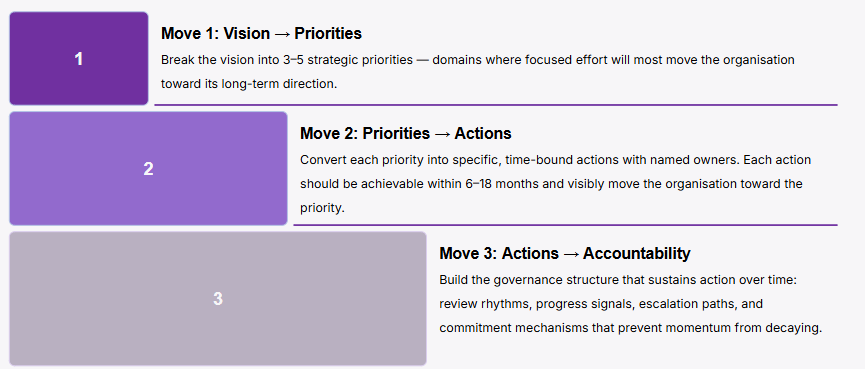
The Three Translation Moves
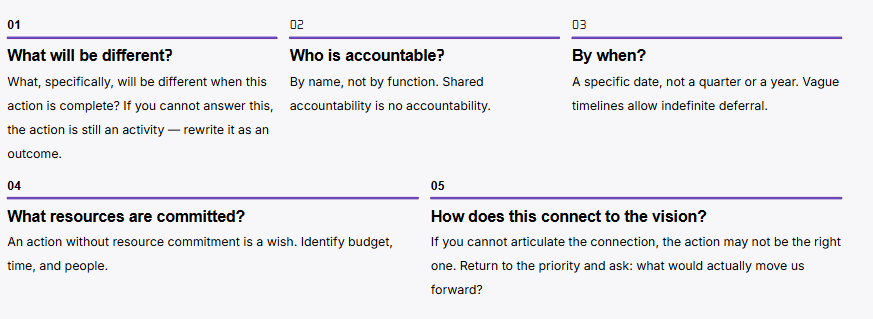
From Priorities to Actions: The Five Quality Questions
Four Accountability Mechanisms for SMEs
The Vision Check-in: A 10–15 minute standing item in an existing regular meeting where progress against vision-linked actions is reviewed and blockers are surfaced. Add it as the first agenda item in your next quarterly review.
The Progress Signal Dashboard: A lightweight shared document tracking 3–5 leading indicators of progress toward the vision — not financial KPIs, but signals that show whether the organisation is moving in the right direction.
The Decision Filter: For any significant decision, ask explicitly: ‘How does this choice affect our progress toward [vision statement]?’ Takes 30 seconds and over time makes the vision a genuine decision-making tool.
The Annual Vision Review: A dedicated two-hour session — separate from regular planning — where the full group that built the vision meets to assess: Is the vision still the right direction? Do the priorities need updating?
Extending the Vision into Ecosystem Partnerships
A shared vision that remains entirely internal is only half-realised. Most meaningful long-term directions require collaboration with partners in the ecosystem.
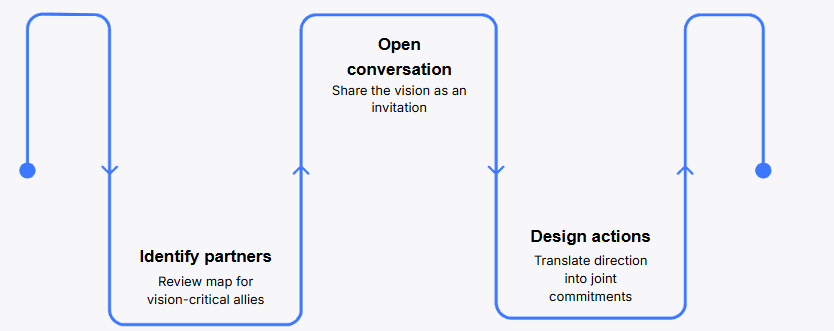
Partners cannot align with a direction they do not know. Share your vision with partners whose alignment would accelerate it. Keep it internal with competitors whose knowledge of your direction would disadvantage you.