

Given your vision, your ecosystem, and your capabilities — where should you position yourself to create the greatest long-term value? Strategic positioning in an ecosystem context is an ongoing process of reading the landscape, making deliberate choices about where to play and how to win, and building the relationships that make your chosen position sustainable.
Why Ecosystem Position Matters for Foresight
Determines What You Can See
Organisations at the centre of dense information flows have earlier access to signals about emerging trends and disruptions than those at the periphery.
Determines What You Can Influence
Some positions carry significant ecosystem influence — the ability to shape standards, attract new entrants, convene stakeholders, or anchor value chains.
Determines What You Are Vulnerable To
A position that is central but highly dependent on a single relationship, or easily replaceable by emerging technology, is fragile regardless of its current strength.
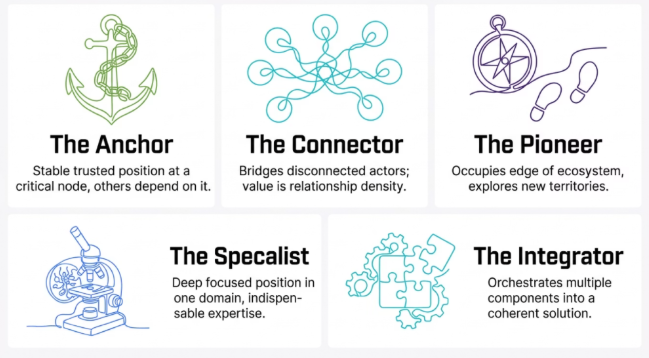
The Five Position Archetypes
Archetype Deep Dive: Anchor & Connector
The Anchor
Holds a stable, trusted position at a critical node. Others depend on the Anchor’s quality, reliability, or network.
Strengths: Structural centrality; high trust; ability to convene others around shared challenges.
Key risk: Disruption that renders the anchoring function obsolete. Risk of becoming a bottleneck.
Signals this fits you: You are the go-to supplier or reference organisation. Relationships are long-term and trust-based.
The Connector
Primary value lies in bridging otherwise disconnected actors — linking technology to market, research to application, or one sector’s capabilities to another’s needs.
Strengths: Access to diverse information flows; ability to spot cross-sector opportunities early.
Key risk: Disintermediation when the actors they connect develop direct relationships.
Signals this fits you: You regularly translate between communities. Your value is in making connections others cannot make.
Archetype Deep Dive: Pioneer, Specialist & Integrator
The Pioneer: Occupies the edge of the current ecosystem — exploring new territories and operating where rules are not yet established. Key risk: Bears the costs of market creation without certainty of capturing its value. Must have a strategy to consolidate before fast-followers arrive.
The Specialist: Holds a deep, highly focused position in one specific domain. Indispensable for any ecosystem actor needing that particular capability. Key risk: Vulnerable to disruption of their specific niche — technological substitution, regulatory change, or commoditisation.
The Integrator: Orchestrates multiple components, capabilities, or actors into a coherent solution worth more than the sum of its parts. Key risk: Dependent on quality of components integrated; vulnerable to vertical integration by component suppliers.
Case Example: When Vision Requires a Position Change
A 22-person cybersecurity consulting firm in France had built a strong Specialist position over 12 years — deeply expert in network security for the financial sector. Their 2023 visioning session produced a clear direction: by 2032, become the leading cybersecurity intelligence partner for mid-market firms across financial and insurance sectors in France and Benelux.
The positioning work revealed the gap: their vision required moving from Specialist toward Connector — adding cross-client, cross-sector bridging capability. That transition demanded three things they did not yet have: a data aggregation platform, reciprocal intelligence-sharing relationships with sector peers, and regulatory clarity on cross-organisation data sharing. Identifying this gap explicitly was not discouraging — it was clarifying.
A Portfolio Approach to Partnerships
For SMEs, partnerships are not supplementary to strategy — they are central to it. The most capable SMEs have deliberately built a portfolio of ecosystem relationships at different levels of investment.
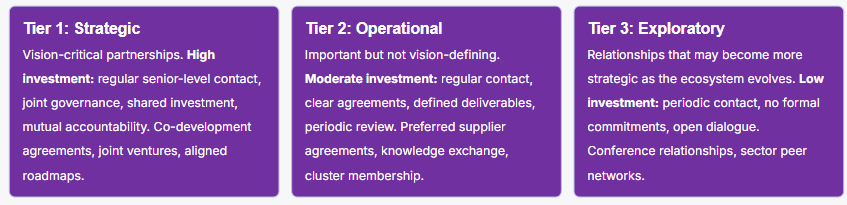
A healthy SME portfolio: 2–3 Tier 1 partnerships, 4–8 Tier 2, and a broader Tier 3 network. Organisations that invest equally in all relationships invest deeply in none.
Six Principles for Partnerships That Last
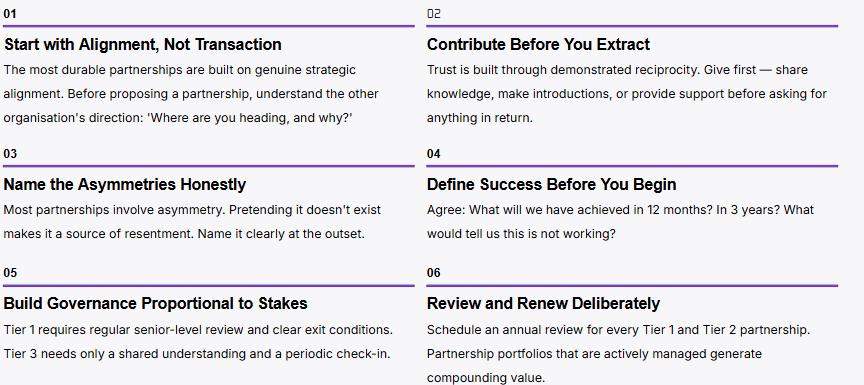
The Partner Canvas
The Partner Canvas is the practical tool for designing, structuring, and reviewing individual strategic partnerships. Complete one canvas per Tier 1 and Tier 2 partner — ideally in dialogue with the partner, not unilaterally.
Part 1 — Partner Profile
- Partner name, sector, and brief description
- Their position in your ecosystem
- Their long-term strategic direction
Part 2 — Strategic Alignment
- Where their direction aligns with your shared vision
- Complementary strengths (what each brings)
- Shared long-term interest — the genuine ‘win-win’
Part 3 — The Partnership Proposition
- What specific collaboration you are proposing
- Their specific contribution
- Your specific contribution (be honest)
- The first concrete step — achievable within 60–90 days
Part 4 — Risk, Trust & Governance
- Potential tensions — named honestly
- Current trust level (High / Moderate / Low)
- Minimum governance structure needed
Portfolio Health: Three Checks
Coverage: Does the portfolio address all three strategic priorities from your vision? No priority should be left without a partnership that accelerates it.
Balance: Does the portfolio include the right mix of near-term operational value (Tier 2) and long-term positioning investment (Tier 1), without over-investing in exploratory relationships that produce little action?
Coherence: Do the partnerships reinforce rather than contradict each other? Where two partners serve the same market, their relationships with you should be known to each other and aligned — not siloed.
If any vision priority has zero partnerships — or all Tier 1 partnerships serve the same priority — you have a portfolio gap that leaves part of your vision without strategic support.