
From Signal to Insight: Impact Mapping
Impact mapping is a structured process to transform isolated observations into meaningful strategic understanding.
Why Systemic Thinking?
Future developments rarely produce one direct consequence. Most changes generate interconnected effects across multiple domains — operational, social, regulatory, and competitive.
The Foresight Imperative
Foresight practitioners must think systemically, not linearly. A single signal can cascade through an entire industry before organisations realise it is relevant to them.
Impact Mapping: The 6-Step Process
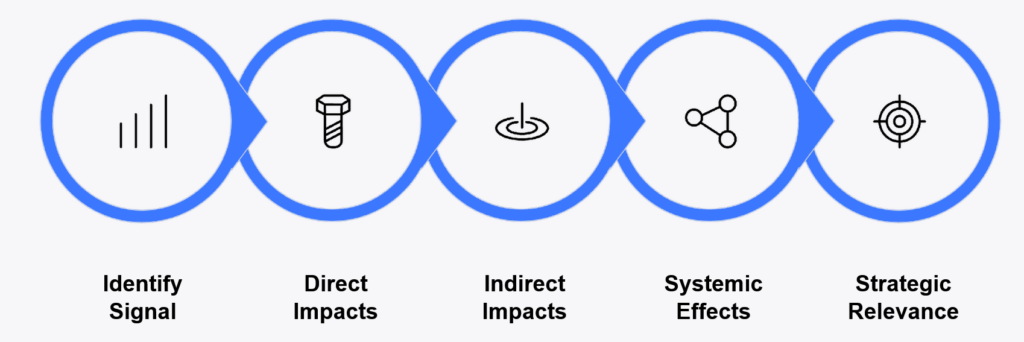
Indirect impacts — step 3 — are frequently the most strategically significant and the most commonly overlooked in rapid analysis sessions.
Trend-to-Impact Mapping
Trend-to-impact mapping is a structured foresight method to analyse how emerging trends create consequences across systems, industries, and society over time.
Organisations that identify trends but fail to evaluate their consequences become reactive instead of proactive.

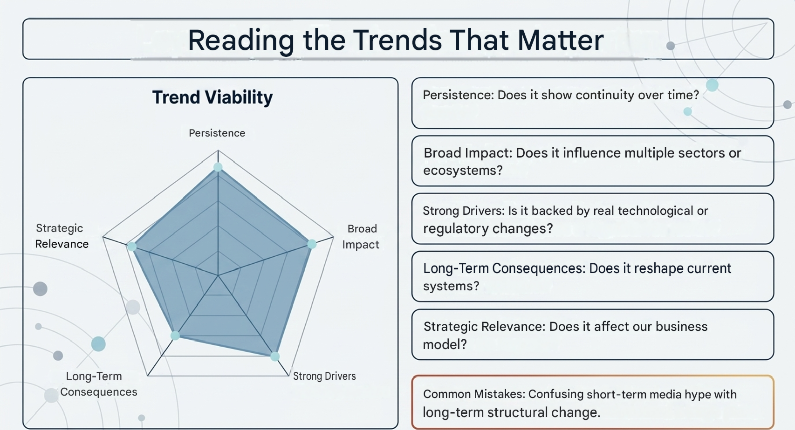
Reading Trends That Matter
Persistence
Digitalisation has developed continuously over decades — durable trends are strategically significant
Broad Impact
AI affects education, healthcare, finance, manufacturing, and public administration simultaneously
Strong Drivers
Renewable energy is driven by climate policy, energy security, technology, and investment — multiple reinforcing forces
Long-Term Consequences
Remote work reshapes labour markets, urban design, and workforce expectations for years ahead
Reading Trends: A 6-Step Process
Detect
Identify observable patterns from news, research, patents, social media
Understand Drivers
What forces support the trend? Who benefits from its continuation?
Evaluate Scale
Which sectors are affected? Is the impact local, regional, or global?
Explore Consequences
Direct and indirect impacts — indirect are often the most strategically important
Assess Time Horizons
Short-term operational effects vs. long-term systemic transformation
Evaluate Uncertainty
Could the trend slow? What barriers, counter-forces, or disruptions may emerge?
Mapping Trend Impacts on Your Business
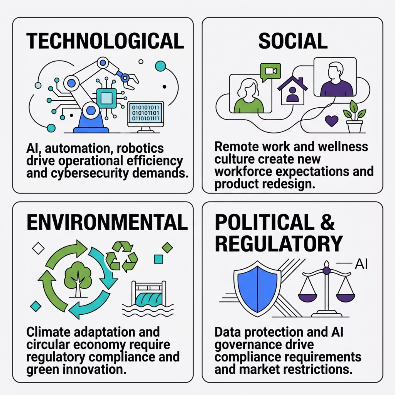
Apply STEEP Thinking
Strategic foresight maps trends across all five domains — not just technology. The most consequential impacts often emerge from the intersection of social, environmental, and regulatory forces.
Political: Data governance and market restrictions
Technological: Efficiency gains and new cybersecurity demands
Social: Workforce expectations and product redesign
Environmental: Circular economy and green compliance
Business Impact Mapping: Opportunities & Risks
Assess Opportunities
Could this create new markets? Improve operational efficiency? Support innovation and competitive differentiation?
Assess Risks
Could this disrupt our business model? Could competitors adapt faster? What capabilities do we lack?
Prioritise impacts by: Magnitude · Urgency · Uncertainty · Strategic relevance
Prioritise impacts by: Magnitude · Urgency · Uncertainty · Strategic relevance
Example — Sustainability trend: Opportunities = circular design, green branding; Risks = regulatory non-compliance, reputational damage